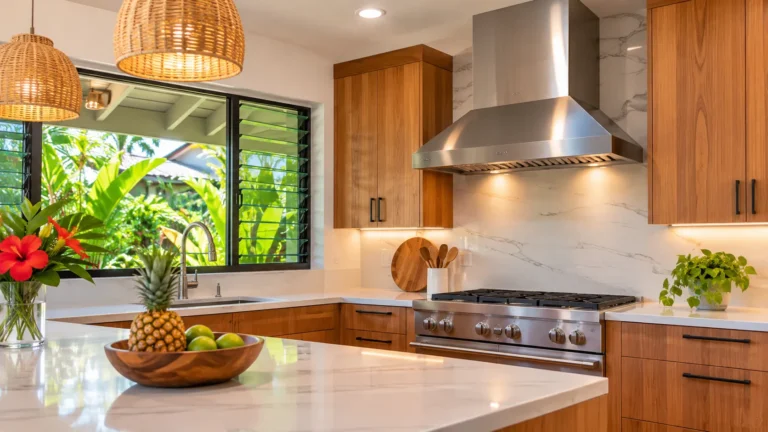
Kitchen lighting in Hawaii plays an important role in creating a kitchen that is beautiful, comfortable, energy-efficient, and practical for everyday living.
Whether you’re remodeling an older Honolulu home, upgrading a kitchen in Kailua, or planning a modern kitchen renovation elsewhere in Hawaiʻi, the right lighting can transform how your space looks and functions.
A successful kitchen lighting design combines three essential layers: task lighting, ambient lighting, and accent lighting.
Each layer serves a different purpose. Together, they improve visibility, highlight architectural features, and create a welcoming environment for cooking, dining, and entertaining.
Planning kitchen lighting in Hawaii starts with understanding how different fixtures support cooking, dining, and everyday activities.
In this guide, United Construction Group explains how to plan kitchen lighting in Hawaii, choose suitable fixtures, avoid common mistakes, and prepare for a successful renovation.
Why Kitchen Lighting in Hawaii Matters
The kitchen is one of the most frequently used spaces in a home. It is where meals are prepared, families gather, and guests are entertained.
Poor lighting can make cooking difficult, create uncomfortable shadows, and reduce the visual appeal of your kitchen.
Thoughtful kitchen lighting in Hawaii can help homeowners:
- Improve visibility around countertops, sinks, and cooking areas.
- Reduce shadows while preparing food.
- Create a welcoming atmosphere for family gatherings.
- Highlight cabinetry, backsplashes, and decorative features.
- Improve lighting efficiency with properly selected LED fixtures.
- Adapt the space for different activities throughout the day.
The right approach to kitchen lighting in Hawaii balances practical illumination, natural daylight, and the overall design of the home.
Hawaiʻi’s natural daylight, coastal conditions, and diverse housing styles can influence how lighting should be designed.
Instead of relying on a single overhead fixture, a layered lighting strategy provides flexibility and better control over the kitchen environment.
1. Task Lighting: Essential Kitchen Lighting in Hawaii
Task lighting provides focused illumination for activities requiring clear visibility.
In a kitchen, this includes chopping vegetables, preparing ingredients, reading recipes, washing dishes, and cooking.
Task lighting is especially important because general ceiling fixtures can cast shadows across countertops.
Best Task Lighting Options for Hawaii Kitchens
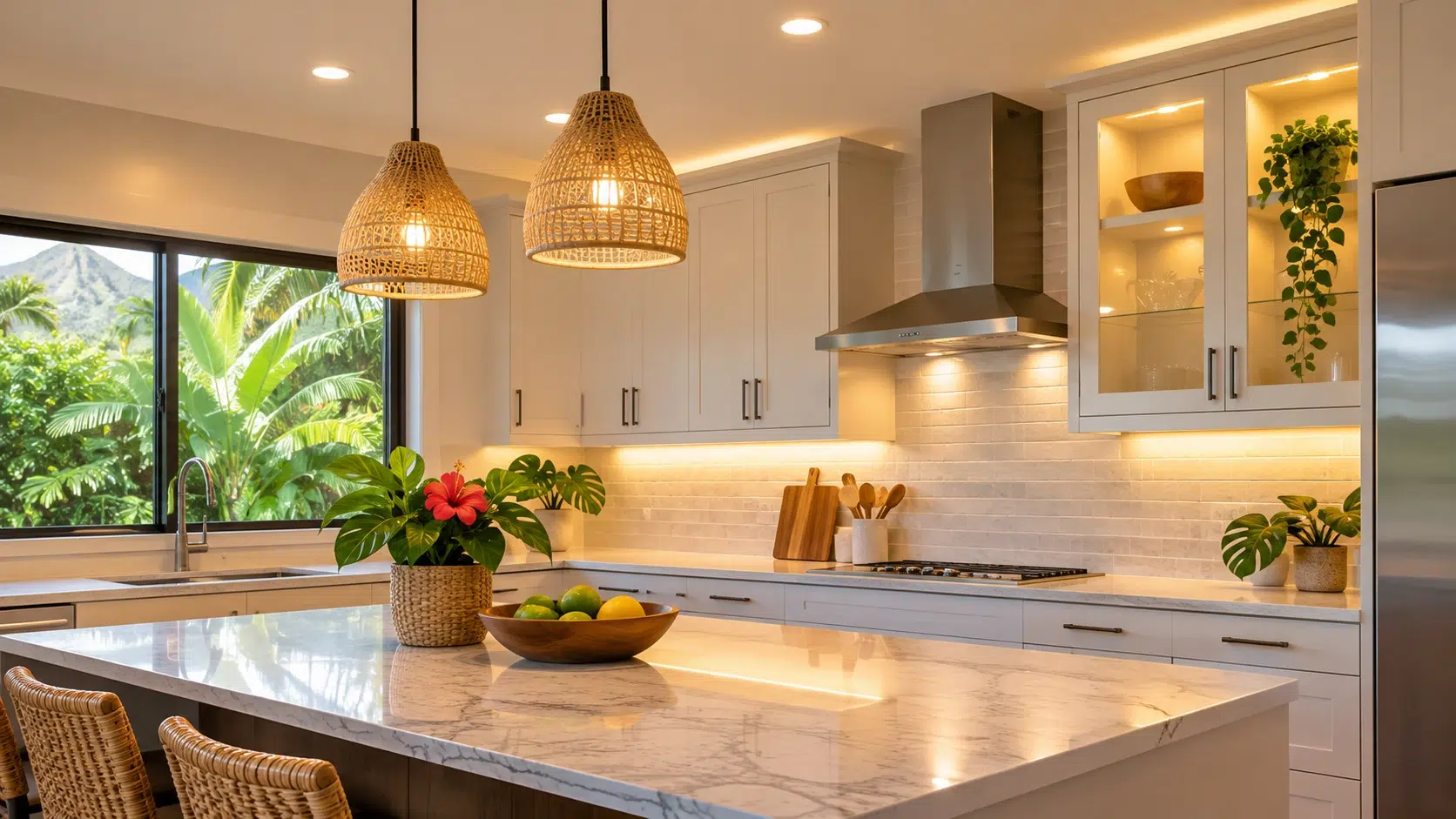
Under-cabinet LED lighting
Under-cabinet fixtures illuminate countertops directly, making them useful for food preparation and other detailed tasks.
LED strips and linear fixtures can be installed beneath upper cabinets to provide consistent illumination across work surfaces.
Kitchen island pendant lighting
Pendant lights can provide useful illumination above kitchen islands while contributing to the room’s design.
However, decorative pendants do not automatically provide sufficient task lighting. Their brightness, beam distribution, and mounting height must be considered.
Recessed task lighting
Properly positioned recessed lights can illuminate sinks, counters, and other work areas.
Fixture placement should account for the user’s position to avoid casting shadows.
Directional lighting
Adjustable fixtures can provide targeted illumination for specific kitchen workstations.
Task Lighting Design Tips
When choosing kitchen lighting in Hawaii, homeowners should prioritize clear visibility around food preparation areas, sinks, and countertops.
Consider these practical recommendations:
- Position fixtures to illuminate work surfaces rather than walkways alone.
- Avoid placing lights where people will block the beam.
- Choose fixtures with appropriate brightness and glare control.
- Coordinate fixture placement with cabinet dimensions.
- Consider separate switches for major task-lighting areas.
Task lighting should make daily activities easier without overwhelming the kitchen with unnecessary brightness.
2. Ambient Lighting: Brighten Your Entire Kitchen
Ambient lighting provides the general illumination needed to move comfortably throughout the kitchen.
It establishes the room’s overall brightness and supports circulation between countertops, appliances, dining areas, and entrances.
Without effective ambient lighting, even a kitchen with attractive decorative fixtures may feel unevenly illuminated.
Popular Ambient Lighting Options
Recessed ceiling lights
Recessed fixtures provide general illumination while maintaining a relatively clean ceiling appearance.
Their spacing and location should be based on the kitchen layout, ceiling height, and fixture performance.
Flush-mounted ceiling lights
These fixtures can work well in kitchens with limited ceiling height or where recessed installation is impractical.
Indirect ceiling lighting
Concealed lighting can reflect light off ceiling surfaces to produce softer general illumination.
Multi-purpose pendant fixtures
Some pendants contribute to both ambient and task lighting, depending on their design and light distribution.
How to Improve Ambient Kitchen Lighting in Hawaii
A successful kitchen lighting in Hawaii plan uses ambient fixtures to provide comfortable brightness throughout the room.
Consider the relationship between artificial lighting and available daylight.
Kitchens with large windows may receive substantial daylight during certain hours but still need dependable general lighting after sunset.
A good ambient lighting plan should:
- Provide comfortable visibility throughout the room.
- Minimize overly bright or dark areas.
- Complement natural daylight.
- Avoid unnecessary glare.
- Support flexible lighting controls.
Dimmable fixtures can be particularly useful when homeowners want brighter lighting for cooking and softer lighting for evening gatherings.
3. Accent Lighting: Highlight Your Kitchen’s Best Features
Accent lighting emphasizes selected architectural and decorative elements.
Unlike task lighting, which serves a practical function, accent lighting primarily enhances the appearance and atmosphere of a space.
It can make cabinetry, shelving, backsplashes, and other design features more visually interesting.
Accent Lighting Ideas for Hawaii Kitchens
Glass cabinet lighting
Integrated lighting inside glass-front cabinets can highlight dishes, decorative objects, and display collections.
Above-cabinet lighting
Concealed LED fixtures can provide a subtle glow above cabinetry.
Backsplash accent lighting
Carefully positioned lighting can emphasize the texture and appearance of a decorative backsplash.
Open-shelf lighting
LED strips beneath or within shelves can highlight selected design features.
Architectural lighting
Concealed fixtures can emphasize ceiling details or other distinctive elements.
Avoid Overusing Accent Lighting
Accent fixtures add another dimension to kitchen lighting in Hawaii by emphasizing cabinetry, decorative shelves, and architectural details.
More lighting does not necessarily create a better kitchen.
Excessive decorative lighting can introduce glare, visual clutter, and unnecessary energy consumption.
Use accent lighting selectively to highlight meaningful features.
The objective is to create visual balance rather than illuminate every decorative surface.
How to Combine the Three Kitchen Lighting Layers
The most effective kitchen lighting design combines task, ambient, and accent lighting into one coordinated plan.
Each layer should complement the others while supporting the kitchen’s layout and daily activities.
Consider the following example:
| Kitchen area | Lighting layer | Suggested fixture |
|---|---|---|
| Food preparation counters | Task | Under-cabinet LEDs |
| Kitchen island | Task and ambient | Pendants or recessed fixtures |
| Main circulation areas | Ambient | Ceiling-mounted lighting |
| Glass-front cabinetry | Accent | Integrated cabinet lighting |
| Kitchen sink | Task | Appropriately positioned overhead fixture |
| Decorative shelves | Accent | Concealed LED strips |
Separating lighting layers into different control groups allows homeowners to adjust the room according to their needs.
For example, cooking may require full task and ambient lighting, while entertaining may call for softer ambient lighting with selected accent fixtures.
A coordinated lighting plan should be developed alongside the kitchen layout, cabinetry, appliances, and electrical design.
Choosing LED Kitchen Lighting in Hawaii
LED lighting is a popular option for residential kitchen renovations because of its energy efficiency, long operating life, and broad range of available fixture designs.
However, homeowners should evaluate more than appearance when choosing LED fixtures.
Choose the Right Color Temperature
Color temperature describes the visual warmth or coolness of a light source.
Common options include:
- 2700K: Warm white lighting that creates a relaxed atmosphere.
- 3000K: Warm white lighting suitable for many residential kitchens.
- 3500K: A balanced, more neutral appearance.
- 4000K: A cooler, neutral-white appearance that some homeowners prefer for detailed work.
For many residential kitchens, 3000K is a useful starting point, although the ideal choice depends on cabinetry, countertops, natural daylight, and homeowner preference.
The U.S. Department of Energy’s lighting guidance explains important considerations when selecting efficient lighting products.
Understand Lumens and Brightness
Lumens measure the amount of visible light produced by a source.
Wattage measures electrical power consumption, not the amount of light reaching a countertop.
When comparing fixtures, consider:
- Lumen output.
- Beam distribution.
- Mounting height.
- Surface reflectance.
- Glare control.
- Intended use.
The goal is to provide useful illumination where it is needed rather than simply installing the brightest available fixtures.
Consider Color Rendering
Color rendering influences how food, cabinetry, countertops, and decorative finishes appear under artificial lighting.
For kitchens where accurate color appearance is important, consider LED products with a Color Rendering Index of 90 or higher.
Check Dimming Compatibility
Energy-efficient kitchen lighting in Hawaii often includes LED fixtures selected for brightness, color consistency, and compatibility with lighting controls.
Not every LED fixture is compatible with every dimmer.
Before installation, verify that the fixtures, drivers, switches, and controls are designed to operate together.
The U.S. Department of Energy’s Energy Saver Guide provides additional information about energy-efficient lighting choices and controls.
Hawaii-Specific Kitchen Lighting Considerations
Designing kitchen lighting in Hawaii involves understanding the conditions of the individual property.
Not every Hawaiʻi home experiences the same climate exposure, electrical limitations, or natural lighting conditions.
A site-specific assessment helps determine the appropriate approach.
Humidity and Coastal Exposure
Some Hawaiʻi properties experience high humidity or exposure to salt-laden air.
These conditions can affect certain metal finishes and electrical components.
Homeowners should review manufacturer specifications and choose fixtures suitable for the actual installation environment.
A kitchen located near the ocean may have different material considerations than a kitchen farther inland.
Natural Daylight
Natural daylight can influence how artificial lighting performs throughout the day.
Window orientation, roof overhangs, surrounding buildings, and landscape features can affect daylight levels.
Consider how sunlight enters the kitchen during morning, afternoon, and evening hours.
Highly reflective countertops and glossy finishes may also require attention to glare.
Existing Electrical Infrastructure
Older homes may have electrical systems that require investigation before additional lighting is installed.
A qualified electrical professional should evaluate relevant conditions, including circuit capacity, wiring, fixture locations, and proposed electrical modifications.
Local Permits and Electrical Requirements
Kitchen lighting renovations may require permits depending on the work and the property’s jurisdiction.
Installing new wiring or modifying circuits may involve different requirements from replacing an existing fixture.
For Oʻahu properties, homeowners can consult the City and County of Honolulu Department of Planning and Permitting for information about permits and electrical work.
Other counties have their own permitting authorities and procedures.
Electrical work should be coordinated with appropriately licensed professionals.
5 Common Kitchen Lighting Mistakes to Avoid
Even an attractive kitchen renovation can be affected by poor lighting decisions.
Here are five mistakes homeowners should consider before starting construction.
Mistake 1: Using Only Overhead Lighting
A single ceiling fixture may illuminate the center of the room but leave countertops shadowed.
Better solution: Combine ambient lighting with dedicated task fixtures.
Mistake 2: Choosing Fixtures Before Finalizing Cabinets
Cabinet dimensions, kitchen islands, and appliance locations affect where lighting should be installed.
Better solution: Finalize major layout decisions before electrical rough-in.
Mistake 3: Ignoring Glare
Poorly positioned fixtures can produce uncomfortable reflections on glossy countertops, backsplashes, and appliances.
Better solution: Evaluate fixture placement, shielding, and surface finishes together.
Mistake 4: Mixing Uncoordinated Light Colors
Combining noticeably different color temperatures can create an inconsistent appearance.
Better solution: Establish a coordinated color-temperature strategy before purchasing fixtures.
Mistake 5: Installing Inflexible Lighting Controls
A single switch controlling every kitchen fixture limits flexibility.
Better solution: Consider separate controls for task, ambient, and accent lighting, with compatible dimming where appropriate.
Avoiding these mistakes can help homeowners achieve a more comfortable and functional kitchen.
How to Plan Kitchen Lighting in Hawaii Before Remodeling
Successful kitchen lighting in Hawaii begins with early planning.
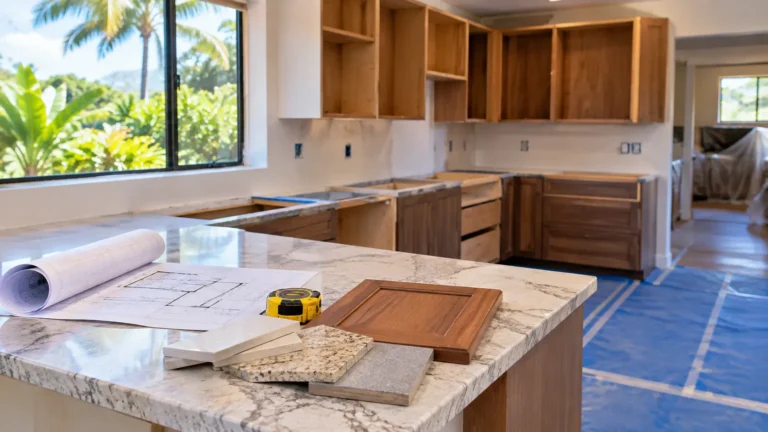
Lighting decisions should be coordinated with cabinetry, countertops, appliances, ventilation, and the overall renovation scope.
Step 1: Assess Existing Conditions
Document the current kitchen layout, ceiling construction, electrical fixtures, cabinet locations, and available daylight.
Identify areas that feel too dark or create unwanted glare.
Step 2: Identify Daily Kitchen Activities
Consider how the household uses the kitchen.
Does the island serve as a food preparation area, dining space, or homework station?
Do multiple people cook at the same time?
These activities influence the lighting plan.
Step 3: Finalize the Kitchen Layout
Confirm major cabinetry, appliance, sink, and island locations.
Fixture placement should support the finished layout rather than an outdated design.
Step 4: Select Fixtures
Compare fixture dimensions, light output, color temperature, installation requirements, and environmental suitability.
Avoid ordering fixtures before confirming compatibility with the proposed design.
Step 5: Coordinate Electrical Work
Review wiring routes, switch locations, circuits, and lighting controls with the project team.
Determine whether permits, inspections, or electrical upgrades are necessary.
Step 6: Review the Final Lighting Plan
Planning kitchen lighting in Hawaii before electrical installation helps homeowners coordinate fixture locations with cabinetry, appliances, and switches.
Before installation, verify that each lighting layer serves its intended purpose.
Confirm fixture specifications, locations, and owner-supplied products.
For additional renovation planning guidance, read United Construction Group’s Kitchen Remodel Guide.
Kitchen Lighting Installation Costs in Hawaii
The cost of kitchen lighting in Hawaii depends on the size of the project, fixture selections, electrical conditions, and installation complexity.
A straightforward fixture replacement generally involves a different scope than installing new circuits, recessed ceiling lights, under-cabinet lighting, and integrated cabinetry fixtures.
Important cost considerations include:
- Number and type of fixtures.
- Electrical wiring and circuit modifications.
- Ceiling access and construction.
- Cabinet integration.
- Dimmers and lighting controls.
- Permits and inspections.
- Shipping and material availability.
- Concealed conditions discovered during renovation.
For island projects, product availability and delivery logistics can also influence scheduling.
Rather than relying on a generic statewide installation price, request a written estimate based on the property’s actual conditions and the proposed scope.
Why Choose United Construction Group for Kitchen Lighting in Hawaii?
Kitchen lighting should be planned as part of the overall kitchen renovation rather than treated as an afterthought.
United Construction Group provides kitchen remodeling services for Hawaiʻi property owners.
Our kitchen remodeling services can help homeowners explore:
- Custom kitchen lighting design.
- Task, ambient, and accent lighting.
- LED lighting upgrades.
- Under-cabinet lighting.
- Pendant lighting options.
- Lighting controls.
- Kitchen cabinetry and layout improvements.
- Electrical and plumbing coordination.
The exact scope, including specialty electrical work, should be confirmed during the project consultation.
By considering lighting alongside cabinetry, countertops, and appliances, homeowners can make more informed renovation decisions.
Explore our Kitchen Remodeling Services in Hawaii to learn more about available options.
Frequently Asked Questions About Kitchen Lighting in Hawaii
What are the three essential layers of kitchen lighting?
The three layers are task lighting, ambient lighting, and accent lighting. Task lighting illuminates work areas, ambient lighting provides general illumination, and accent lighting highlights decorative or architectural features.
What is the best kitchen lighting in Hawaii?
The best kitchen lighting in Hawaii combines appropriate task, ambient, and accent lighting. Fixture selection should consider the kitchen layout, available daylight, electrical conditions, and homeowner preferences.
Is LED lighting good for Hawaii kitchens?
Yes. LED lighting can be an energy-efficient option for residential kitchens. Choose products based on brightness, color quality, dimming compatibility, and environmental suitability.
What color temperature should I use in my kitchen?
Many homeowners prefer warm-white lighting around 3000K. Others choose 3500K or 4000K for a more neutral appearance. The ideal choice depends on the kitchen’s finishes, natural light, and intended atmosphere.
Should kitchen islands have pendant lights?
Pendant lighting is popular above kitchen islands, but it is not mandatory. Recessed or other properly designed fixtures can also provide effective illumination.
Are under-cabinet lights necessary?
Under-cabinet lighting is not required in every kitchen, but it can improve countertop visibility and reduce shadows from overhead fixtures.
Can I upgrade kitchen lighting without a complete remodel?
Often, yes. Some lighting improvements can be completed independently of a full renovation. The feasibility depends on existing wiring, fixture locations, cabinetry, and the proposed changes.
Do I need an electrical permit for kitchen lighting in Hawaii?
Possibly. Permit requirements depend on the type of electrical work and the county. Consult the relevant permitting authority and qualified professionals before beginning installation.
How much does kitchen lighting installation cost in Hawaii?
Installation costs vary with fixture selection, wiring conditions, labor requirements, and project location. A site-specific written estimate is the most reliable way to understand the likely cost.
When should kitchen lighting be planned during remodeling?
Lighting should be planned during the initial design stage, before cabinetry is finalized and electrical rough-in begins. Early coordination can reduce conflicts and avoidable changes.
Transform Your Kitchen With United Construction Group
Beautiful kitchen lighting is about more than choosing attractive fixtures.
The right combination of task, ambient, and accent lighting can make your kitchen more practical, comfortable, and visually appealing.
Whether you’re planning a simple lighting upgrade or a complete kitchen renovation, thoughtful design and proper installation can make a meaningful difference.
For homeowners considering kitchen lighting in Hawaii, a coordinated renovation plan can improve functionality, comfort, and the finished appearance of the space.
United Construction Group helps Hawaiʻi homeowners plan kitchen renovations with attention to layout, lighting, materials, and construction requirements.
Explore our Kitchen Remodeling Services and take the next step toward a more functional kitchen.
Ready to discuss your kitchen lighting in Hawaii? Contact United Construction Group to request a project consultation.