Kitchen ventilation in Hawaii is one of the most important considerations when designing, renovating, or building a residential kitchen. Although homeowners often prioritize attractive cabinetry, modern appliances, and durable countertops, an effective ventilation system is equally important for maintaining a comfortable and functional living environment.
Hawaii’s tropical climate, humidity, coastal exposure, and indoor-outdoor lifestyles create unique considerations for residential kitchen design. Without effective ventilation, everyday cooking can contribute to lingering odors, airborne grease, excess moisture, and uncomfortable indoor temperatures.
Proper kitchen ventilation in Hawaii requires more than simply installing a range hood. It involves coordinating exhaust capacity, ductwork, appliance specifications, natural airflow, moisture management, and construction requirements.
Whether you are remodeling an older Honolulu home, upgrading an Oʻahu condominium, or designing a custom residential property, understanding these requirements early can help reduce unnecessary construction changes and expenses.
At United Construction Group, we believe that successful kitchen remodeling begins with thoughtful planning and a clear understanding of the property’s existing conditions.
This comprehensive guide explains 10 essential tips for improving kitchen ventilation in Hawaii and creating a more comfortable, practical, and enjoyable kitchen.
Why Kitchen Ventilation in Hawaii Is Essential
Cooking generates heat, moisture, airborne grease, odors, and fine particles. Gas cooking appliances can also produce combustion-related pollutants.
According to the United States Environmental Protection Agency (EPA), using an outdoor-vented range hood during cooking can help reduce exposure to cooking-related indoor air pollutants.
Effective kitchen ventilation in Hawaii can provide several practical benefits:
- Helps remove cooking odors.
- Reduces airborne grease accumulation.
- Removes captured cooking-generated moisture.
- Supports better indoor air quality.
- Improves comfort during meal preparation.
- Helps protect cabinetry and surrounding finishes.
- Reduces the spread of cooking emissions into adjoining rooms.
- Supports a more functional kitchen layout.
For homeowners planning a renovation, ventilation should be considered an essential building system rather than an optional appliance upgrade.
1. Assess Your Existing Kitchen Ventilation in Hawaii
Before purchasing new appliances or finalizing renovation plans, evaluate the existing kitchen ventilation system.
Older Hawaii homes may have outdated exhaust equipment, restricted ductwork, or kitchen layouts that no longer accommodate modern cooking habits.
A professional site assessment can help identify whether existing components can be reused or whether improvements are necessary.
What Should Homeowners Inspect?
Start by reviewing the following:
- Existing range hood condition.
- Exhaust fan performance.
- Existing ductwork and connections.
- Exterior exhaust termination.
- Cooking appliance dimensions.
- Electrical connections.
- Cabinetry and ceiling clearances.
- Signs of moisture accumulation.
- Visible corrosion or deterioration.
- Natural airflow opportunities.
Evaluating existing kitchen ventilation in Hawaii before construction begins can help identify potential challenges that may otherwise become apparent after demolition.
Warning Signs of Poor Kitchen Ventilation
Common indicators include:
- Cooking odors that remain for extended periods.
- Grease accumulation on upper cabinets.
- Excessive condensation around cooking areas.
- Smoke spreading into living spaces.
- Uncomfortable temperatures while preparing meals.
- Unusual exhaust fan noise.
- Visible moisture-related damage.
These symptoms do not automatically mean that a complete ventilation replacement is required. Cleaning, maintenance, equipment upgrades, or ductwork improvements may address certain problems.
A qualified contractor can help determine the appropriate next steps.
2. Choose the Best Range Hood for Kitchen Ventilation in Hawaii
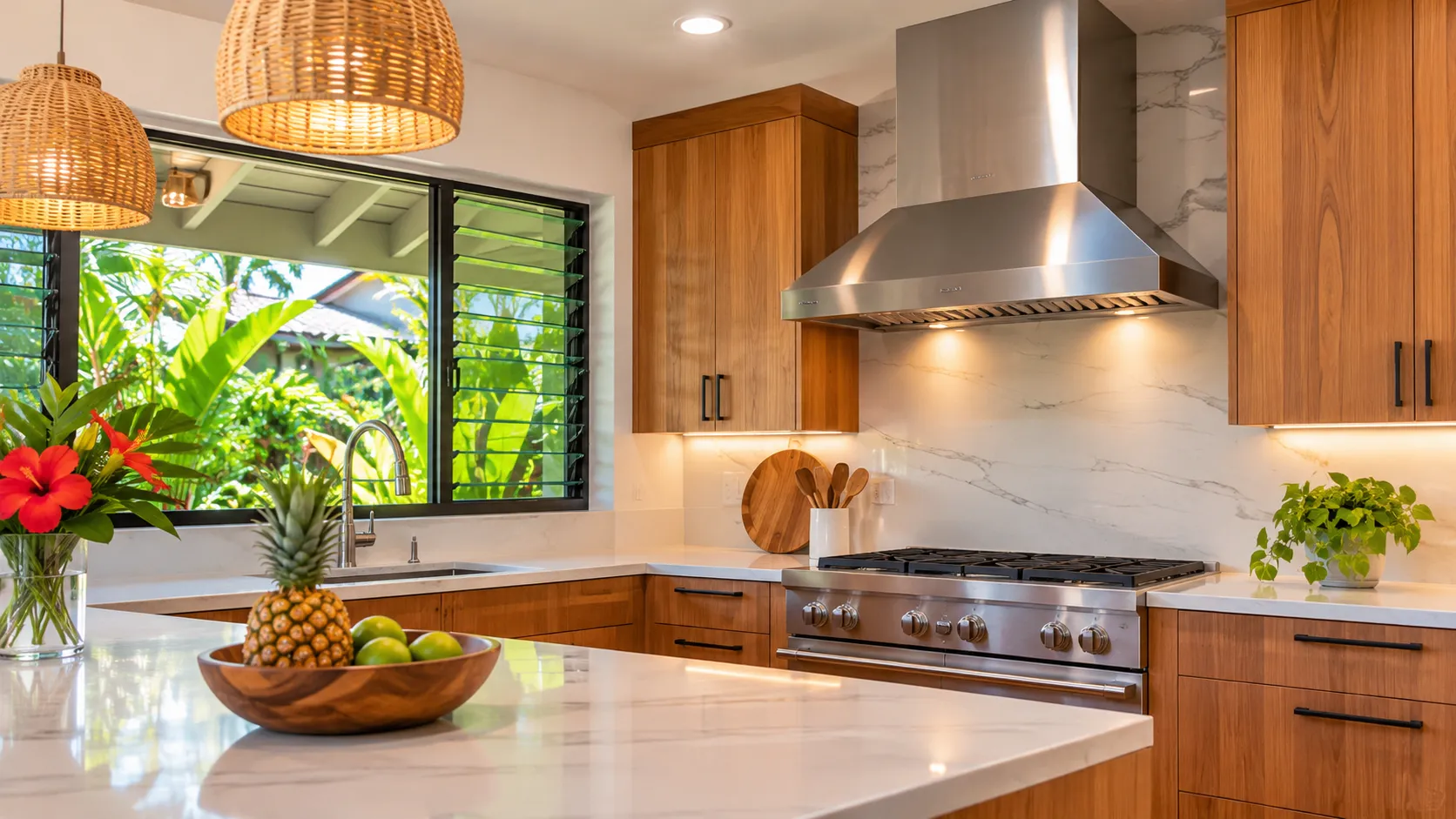
A range hood is a central component of an effective kitchen ventilation system.
Choosing the right equipment requires consideration of cooking habits, appliance specifications, available space, and building conditions.
Homeowners should understand the differences between ducted and ductless range hoods before making a purchase.
Ducted Range Hoods
Ducted range hoods capture cooking emissions and discharge the captured air outdoors through an exhaust duct.
Potential advantages include:
- Direct removal of captured cooking emissions.
- Improved cooking odor management.
- Removal of captured moisture and heat.
- Reduced recirculation of cooking pollutants.
Outdoor-vented equipment is generally preferred when building conditions and applicable requirements allow installation.
Ductless Range Hoods
Ductless range hoods use filters to capture certain airborne contaminants before recirculating air into the kitchen.
They may be considered where installing exterior ductwork is difficult or restricted.
However, ductless systems do not directly remove cooking-generated moisture or heat from the building.
Ducted vs. Ductless Range Hoods
| Feature | Ducted Range Hood | Ductless Range Hood |
|---|---|---|
| Air discharge | Outdoors | Recirculated indoors |
| Moisture removal | Removes captured moisture | Limited |
| Heat removal | Removes captured heated air | Limited |
| Ductwork required | Yes | No |
| Filter maintenance | Required | Required |
| Installation complexity | Generally higher | Generally lower |
| Common application | Homes with feasible exhaust routes | Properties with ducting restrictions |
Selecting equipment for kitchen ventilation in Hawaii should be based on actual building conditions rather than appearance or purchase price alone.
3. Determine the Correct Kitchen Ventilation Capacity
Range hood airflow is commonly measured in cubic feet per minute, also known as CFM.
This measurement describes how much air a ventilation system moves within a specified period.
However, selecting the highest available CFM rating does not automatically provide the best performance.
Effective kitchen ventilation in Hawaii depends on matching the equipment to the cooking appliance, duct configuration, and building conditions.
Factors That Influence Ventilation Capacity
Important considerations include:
- Cooking appliance type.
- Cooking surface dimensions.
- Range hood coverage.
- Manufacturer installation specifications.
- Cooking frequency and intensity.
- Exhaust duct diameter.
- Duct length and number of bends.
- Building airtightness.
- Applicable mechanical requirements.
A properly selected range hood should provide suitable capture performance without creating unnecessary building pressure problems.
Understanding Makeup Air
Makeup air is replacement air introduced into a building to compensate for air removed by exhaust equipment.
High-capacity exhaust systems may create negative indoor pressure when adequate replacement air is unavailable.
This can be particularly important in homes with naturally drafting combustion appliances because pressure imbalances may interfere with safe appliance operation.
Depending on the equipment, building design, and applicable codes, a dedicated makeup air system may be necessary.
A qualified professional should evaluate these requirements before equipment installation.
4. Plan Kitchen Exhaust Ductwork Before Construction
One of the most avoidable kitchen remodeling mistakes is selecting cabinetry and appliances before confirming the exhaust duct route.
Planning kitchen ventilation in Hawaii during the design stage allows the project team to coordinate mechanical requirements with cabinetry, structural elements, electrical systems, and exterior finishes.
Poorly planned ductwork can contribute to:
- Reduced exhaust performance.
- Increased equipment noise.
- Additional construction labor.
- Unexpected cabinetry modifications.
- Ceiling or wall alterations.
- Increased renovation expenses.
Kitchen Exhaust Ductwork Requirements
A well-planned exhaust system should consider:
- Manufacturer-approved duct materials.
- Appropriate duct diameter.
- Practical duct routing.
- Limited unnecessary bends.
- Exterior exhaust termination.
- Weather protection.
- Maintenance accessibility.
The U.S. Department of Energy provides building science and energy-efficiency resources that can support informed residential ventilation planning.
Kitchen exhaust should discharge outdoors rather than into an attic, crawlspace, or concealed ceiling cavity.
Proper ductwork coordination is especially important when improving kitchen ventilation in Hawaii homes with limited ceiling space or existing structural constraints.
Confirming the exhaust route before cabinetry fabrication can help prevent expensive modifications later in the project.
5. Manage Humidity With Proper Kitchen Ventilation in Hawaii
Hawaii’s tropical environment makes moisture management an important consideration in residential construction.
Humidity levels vary depending on location, elevation, weather patterns, and building conditions.
Everyday cooking activities such as boiling, steaming, and simmering introduce additional moisture into indoor spaces.
When moisture is not adequately managed, it may contribute to:
- Condensation on surfaces.
- Swelling of moisture-sensitive materials.
- Cabinetry deterioration.
- Musty odors.
- Conditions favorable to mold growth.
- Increased maintenance requirements.
Practical Ways to Manage Kitchen Moisture
Homeowners can support moisture management by:
- Using an appropriately designed outdoor-vented range hood.
- Operating the exhaust system during cooking.
- Maintaining grease filters.
- Addressing plumbing leaks promptly.
- Selecting suitable construction materials.
- Monitoring indoor humidity.
- Coordinating ventilation with air conditioning or dehumidification.
The EPA’s guide to mold and moisture explains the importance of controlling moisture to help prevent mold growth.
Proper kitchen ventilation in Hawaii can help remove cooking-generated moisture, but it should form part of a broader moisture management strategy.
Ventilation cannot resolve underlying plumbing leaks, roof leaks, or persistent moisture intrusion.
6. Select Materials Suitable for Hawaii’s Coastal Environment
Many Hawaii properties experience varying degrees of exposure to salt-laden air.
Coastal exposure can contribute to the deterioration of susceptible metal components over time.
When designing kitchen ventilation in Hawaii, homeowners should consider the environmental conditions surrounding their property.
Ventilation Components That May Require Additional Protection
These include:
- Exterior exhaust covers.
- Metal fasteners.
- Exhaust dampers.
- Ventilation fan housings.
- Duct connections.
- Mounting hardware.
- Protective coatings.
Choosing Corrosion-Resistant Materials
Depending on the application, appropriate stainless steel components, approved protective finishes, and corrosion-resistant hardware may be suitable.
Material selection should account for manufacturer requirements, equipment compatibility, and actual environmental exposure.
Not every Hawaii property experiences the same coastal conditions. A home near the ocean may have different maintenance requirements from a property located farther inland.
Routine inspection can help identify deterioration before it affects ventilation performance.
Discuss material suitability with your construction team before finalizing equipment and installation details.
7. Combine Natural Airflow With Mechanical Kitchen Ventilation
Hawaii homes frequently incorporate indoor-outdoor living features, operable windows, and open floor plans.
These design elements can support natural airflow and improve everyday comfort when outdoor conditions are suitable.
However, natural airflow should complement rather than automatically replace dedicated cooking exhaust.
Effective kitchen ventilation in Hawaii combines thoughtful architectural design with appropriate mechanical ventilation.
Natural Ventilation Features to Consider
Depending on the property, homeowners may benefit from:
- Operable windows.
- Sliding glass doors.
- Cross-ventilation opportunities.
- Connections to covered outdoor spaces.
- Thoughtful window placement.
- Open interior circulation.
Outdoor humidity, rainfall, air quality, and wind direction can influence how effectively these features support ventilation.
Strong crosswinds near the cooking surface may also interfere with a range hood’s ability to capture cooking emissions.
Open-Concept Kitchen Ventilation in Hawaii
Open-concept kitchens require particular attention because cooking odors, heat, and airborne particles can spread directly into living and dining areas.
When planning an open kitchen, consider:
- Cooking island placement.
- Range hood coverage.
- Ceiling height.
- Exhaust duct routing.
- Equipment noise.
- Air conditioning performance.
- Natural airflow patterns.
Coordinating these elements can help homeowners maintain an open, inviting kitchen without overlooking practical ventilation requirements.
8. Understand Kitchen Ventilation Requirements in Hawaii
Before installing or modifying kitchen ventilation equipment, homeowners should determine whether the proposed work requires permits, professional design, or additional approvals.
Requirements depend on the property’s location, building classification, adopted construction codes, and project scope.
Kitchen ventilation in Hawaii may involve mechanical, electrical, structural, and building-related requirements.
Construction Work That May Require Additional Review
Depending on the project, these activities may require review:
- Creating new exterior wall penetrations.
- Modifying roof structures.
- Installing new electrical circuits.
- Altering existing mechanical systems.
- Modifying fire-rated construction.
- Installing dedicated makeup air equipment.
- Changing shared building infrastructure.
For properties on Oʻahu, consult the City and County of Honolulu Department of Planning and Permitting regarding applicable construction and permitting requirements.
A qualified contractor or design professional can help determine which requirements apply to the proposed renovation.
Kitchen Ventilation in Hawaii Condominiums
Condominium renovations may involve additional considerations because certain walls, exterior components, and mechanical systems may form part of the building’s common elements.
Homeowners should review association rules and renovation procedures before purchasing equipment or authorizing construction.
Building management approval may be necessary when proposed work affects shared systems or exterior building components.
Early coordination can help avoid purchasing equipment that cannot be installed within the property’s restrictions.
9. Coordinate Ventilation With Cabinetry and Appliance Selection
A successful kitchen remodel requires careful coordination between multiple construction trades.
Appliances, cabinetry, lighting, electrical systems, countertops, and ventilation equipment must work together within the available space.
Planning kitchen ventilation in Hawaii before finalizing these selections can help reduce design conflicts and construction delays.
For example, moving a cooking appliance from an exterior wall to a kitchen island may require a different exhaust route and range hood configuration.
Similarly, installing taller upper cabinets may affect available ductwork space and equipment clearances.
Kitchen Ventilation Planning Checklist
Before approving the final kitchen design, confirm:
- Cooking appliance dimensions.
- Range hood specifications.
- Manufacturer-required mounting clearances.
- Exhaust duct location.
- Electrical connection requirements.
- Cabinetry dimensions.
- Structural support requirements.
- Makeup air considerations.
- Exterior exhaust termination.
- Filter cleaning and replacement access.
Documenting these details before ordering appliances and cabinetry can support better coordination throughout the construction process.
Homeowners preparing for a renovation can explore United Construction Group’s kitchen remodeling services in Hawaii to learn more about planning a residential kitchen project.
10. Budget for Kitchen Ventilation Installation and Maintenance
A realistic renovation budget should account for both initial installation expenses and long-term maintenance.
The cost of kitchen ventilation in Hawaii varies depending on equipment selection, existing building conditions, installation complexity, and applicable requirements.
Factors That Affect Kitchen Ventilation Costs
| Cost factor | Potential budget impact |
|---|---|
| Range hood selection | Equipment purchase |
| Existing ductwork | Cleaning, repair, or replacement |
| New exhaust routes | Additional construction labor |
| Exterior penetrations | Weatherproofing and finishing |
| Electrical upgrades | Wiring and circuit requirements |
| Makeup air equipment | Additional mechanical installation |
| Cabinetry modifications | Fabrication and adjustments |
| Site accessibility | Labor and material logistics |
| Permits and design | Project-specific compliance expenses |
Rather than relying on generic construction estimates, homeowners should request pricing based on the actual property and a clearly defined scope of work.
Maintaining Kitchen Ventilation in Hawaii
Routine maintenance supports equipment performance and helps manage grease accumulation.
Homeowners should follow manufacturer recommendations for:
- Cleaning grease filters.
- Replacing applicable charcoal filters.
- Cleaning accessible range hood surfaces.
- Checking accessible exhaust components.
- Monitoring unusual equipment noise.
- Arranging professional servicing when necessary.
The EPA recommends using an outdoor-vented range hood while cooking and continuing to operate it for approximately 10 to 20 minutes afterward.
Selecting equipment that is easy to operate and maintain can encourage consistent use and support better long-term performance.
Common Kitchen Ventilation Mistakes to Avoid
Kitchen remodeling projects can become more complicated when ventilation decisions are delayed until construction is already underway.
Some common mistakes include:
- Choosing appliances before evaluating ventilation requirements.
- Selecting a range hood based solely on appearance.
- Assuming higher airflow always means better performance.
- Overlooking makeup air requirements.
- Ignoring ductwork limitations.
- Failing to consider coastal exposure.
- Relying exclusively on natural airflow.
- Overlooking condominium restrictions.
- Selecting equipment that is excessively noisy.
- Failing to confirm maintenance accessibility.
Addressing kitchen ventilation in Hawaii during preconstruction allows homeowners to make more informed decisions before committing to equipment purchases and construction work.
Kitchen Ventilation Planning Checklist for Hawaii Homeowners
Before beginning your kitchen renovation, use this checklist to organize your project requirements.
- Assess existing ventilation equipment.
- Document cooking appliance specifications.
- Identify feasible exhaust duct routes.
- Evaluate natural airflow opportunities.
- Review moisture management requirements.
- Consider coastal exposure.
- Confirm applicable permitting requirements.
- Review condominium restrictions where applicable.
- Coordinate cabinetry and appliance selections.
- Establish installation and maintenance budgets.
- Discuss makeup air with qualified professionals.
- Confirm equipment operation during project closeout.
This checklist can help homeowners prepare for a more productive conversation with their construction team.
Frequently Asked Questions About Kitchen Ventilation in Hawaii
What is the best kitchen ventilation system for Hawaii homes?
An appropriately sized range hood that exhausts outdoors is generally preferred when building conditions allow. The final selection should account for cooking habits, appliance specifications, ductwork, humidity, and applicable construction requirements.
Why is kitchen ventilation in Hawaii important?
Effective ventilation helps remove captured cooking emissions, moisture, heat, and odors. It can support indoor air quality, improve cooking comfort, and help manage grease accumulation on surrounding surfaces.
Is a ducted range hood better than a ductless range hood?
A ducted range hood discharges captured cooking emissions outdoors. A ductless range hood filters and recirculates air but does not directly remove cooking-generated heat or moisture from the building.
Can opening windows replace a kitchen range hood?
Opening windows can supplement ventilation when weather and outdoor air quality permit. However, natural airflow does not provide the same targeted capture of cooking emissions as a properly designed range hood.
How many CFM does my kitchen range hood need?
The appropriate airflow depends on appliance specifications, hood design, cooking habits, duct configuration, and applicable mechanical requirements. A qualified professional should evaluate these factors before equipment selection.
Does kitchen ventilation in Hawaii help prevent mold?
Effective kitchen exhaust can help reduce cooking-generated moisture, supporting overall moisture management. However, ventilation alone cannot eliminate mold risks associated with leaks, persistent humidity, or other moisture sources.
Do I need a permit to install a range hood in Hawaii?
Permit requirements depend on the project scope and jurisdiction. New electrical work, structural alterations, exterior penetrations, and mechanical modifications may require permits or additional approvals.
Can I install a range hood in a Hawaii condominium?
Potentially. Installation depends on building conditions, available exhaust routes, association requirements, and applicable construction codes. Building management approval may be required.
Do induction cooktops require ventilation?
Although induction cooktops do not generate combustion emissions at the cooking surface, cooking food can still produce grease, moisture, odors, and airborne particles. Appropriate exhaust ventilation remains beneficial.
How often should kitchen range hood filters be cleaned?
Cleaning frequency depends on cooking habits, filter type, and manufacturer recommendations. Households that frequently fry or cook with oils may require more frequent filter maintenance.
Can kitchen ventilation be improved without a complete remodel?
Yes. Depending on existing conditions, equipment replacement, ductwork improvements, filter maintenance, or other targeted upgrades may improve ventilation without a complete kitchen renovation.
When should I plan kitchen ventilation in Hawaii?
Ventilation should be evaluated during the initial planning and design stages, before finalizing cabinetry, appliances, electrical requirements, and construction details.
Build a Better Kitchen With United Construction Group
A thoughtfully designed kitchen should provide more than attractive finishes. It should support the way your household cooks, gathers, and lives every day.
Proper kitchen ventilation in Hawaii begins with understanding existing building conditions, selecting suitable equipment, and coordinating mechanical requirements with the overall renovation design.
Whether you are renovating an older Honolulu home, upgrading your Oʻahu kitchen, or planning a larger residential construction project, addressing ventilation early can help reduce avoidable construction changes.
United Construction Group understands the importance of thoughtful planning, construction coordination, and property-specific solutions.
Our approach encourages homeowners to consider functionality, durability, and long-term maintenance alongside their design preferences.
Ready to create a more comfortable and functional kitchen?
Explore our kitchen remodeling services in Hawaii or contact United Construction Group to discuss your next construction project.
Let’s build a kitchen that works beautifully for your lifestyle and Hawaii’s unique environment.