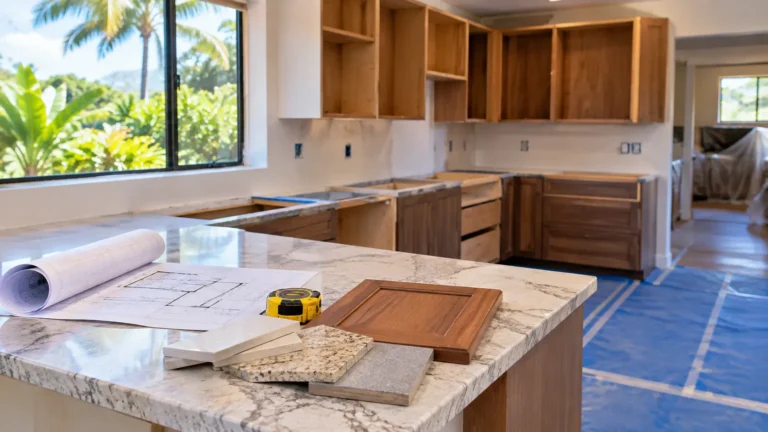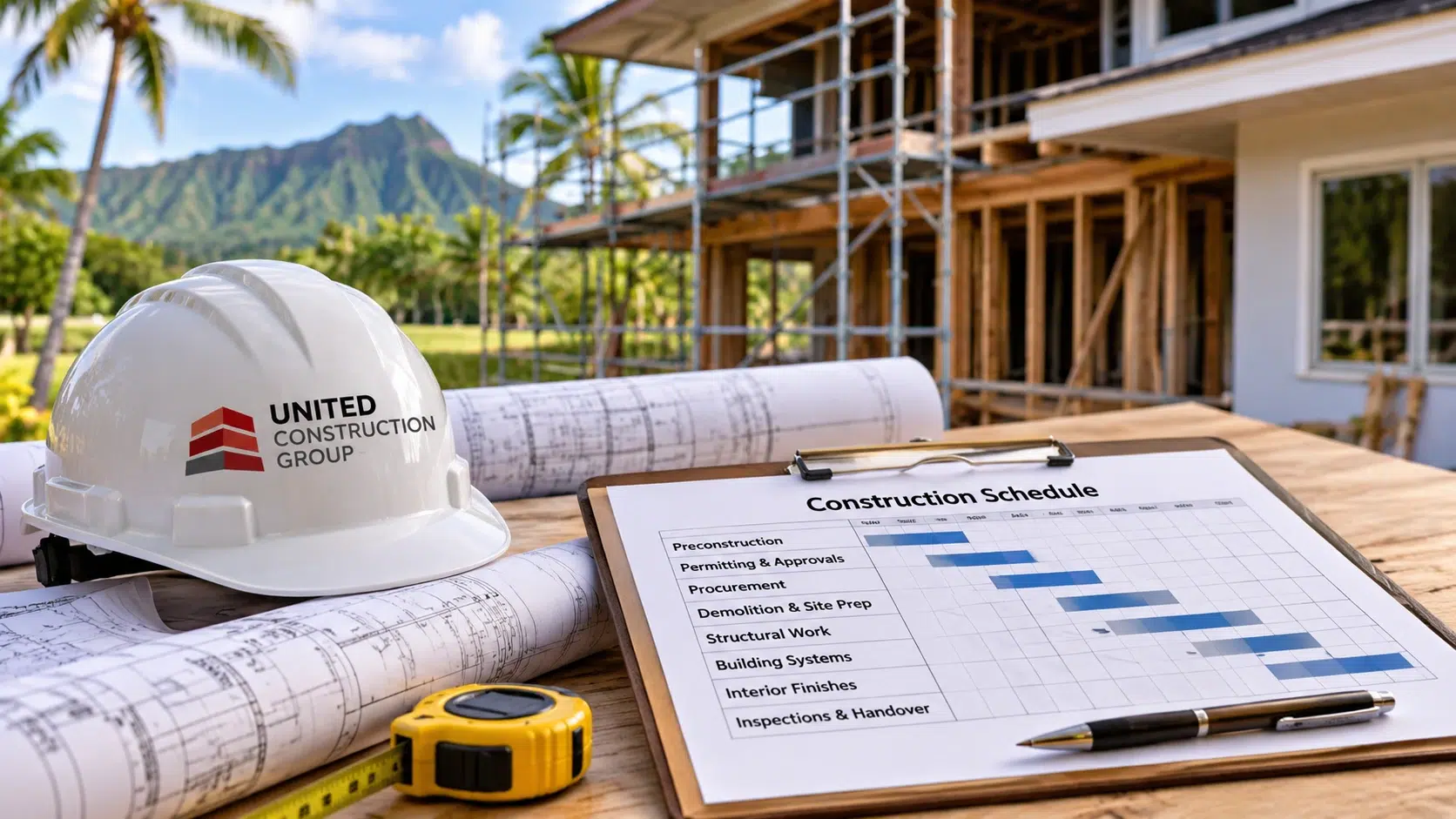
Understanding what to expect from a construction schedule in Hawaii is essential for homeowners and business owners preparing for renovations, home additions, commercial build-outs, or new construction.
A construction schedule is more than a projected start and completion date. It outlines the sequence of work, major milestones, inspections, material deliveries, and decisions needed to keep a project moving.
In Hawaii, construction schedules may also be influenced by county permitting requirements, shipping logistics, rainfall, site access, and the availability of specialized trades.
Knowing what to expect from a construction schedule in Hawaii can help property owners ask better questions, recognize potential delays, and understand their responsibilities throughout construction.
At United Construction Group, project planning begins with reviewing site conditions, defining the scope of work, coordinating project requirements, and establishing a construction schedule.
This guide explains seven costly scheduling mistakes to avoid, the typical phases of construction, and how to evaluate a realistic project timeline.
1. What to Expect From a Construction Schedule in Hawaii: The Main Phases
A construction schedule organizes project activities into a logical sequence.
Although every project is different, most construction schedules include several common phases.
Phase 1: Preconstruction Planning
Preconstruction establishes the information needed before physical work begins.
Activities may include:
- Reviewing project goals and requirements.
- Conducting a site assessment.
- Evaluating existing building conditions.
- Preparing or reviewing construction drawings.
- Defining the scope of work.
- Developing preliminary estimates.
- Identifying permit requirements.
- Establishing initial scheduling assumptions.
The schedule should identify which decisions must be completed before construction can begin.
For example, a kitchen renovation involving significant layout changes may require plumbing and electrical coordination before demolition starts.
Understanding what to expect from a construction schedule in Hawaii begins with recognizing that design and preconstruction activities can influence the overall project duration.
Phase 2: Permitting and Approvals
Some construction projects require building permits, plan reviews, inspections, or additional approvals.
Requirements depend on the work and the applicable county.
On Oʻahu, the City and County of Honolulu Department of Planning and Permitting administers building permit review and related processes.
Permit review duration can vary based on project complexity, documentation, agency review, and required corrections.
Understanding what to expect from a construction schedule in Hawaii means recognizing that permit review and construction activities follow different timelines. Property owners should confirm which approvals are required before establishing a firm construction start date.
For current information, visit the Honolulu Department of Planning and Permitting.
Scheduling tip: Distinguish between an anticipated permit approval date and an actual permit issuance date. Do not assume construction can legally begin simply because an application has been submitted.
Phase 3: Procurement and Material Deliveries
Construction materials must be available when the project reaches the relevant installation stage.
Procurement planning may include:
- Confirming product specifications.
- Obtaining supplier quotations.
- Approving material selections.
- Placing purchase orders.
- Tracking manufacturing lead times.
- Coordinating shipping.
- Scheduling deliveries.
- Inspecting materials upon arrival.
Some materials used in Hawaii construction are shipped from outside the islands.
Shipping availability, supplier lead times, and product substitutions can influence project sequencing.
However, these conditions do not affect every material or project equally.
Another important part of what to expect from a construction schedule in Hawaii is identifying materials that require early ordering. Cabinetry, specialized equipment, windows, and custom finishes may have procurement timelines that influence subsequent construction activities.
Homeowners should ask which products have long lead times and when selections must be finalized.
Phase 4: Site Preparation and Demolition
Once the project is authorized to proceed, physical construction may begin with site preparation.
Depending on the work, activities can include:
- Protecting existing finishes.
- Establishing safe access routes.
- Installing temporary barriers.
- Coordinating waste removal.
- Disconnecting affected utilities.
- Removing existing finishes or structures.
- Preparing areas for new construction.
Demolition may reveal concealed conditions that were not visible during the initial assessment.
These discoveries can affect the schedule if additional investigation, design changes, or repairs are necessary.
Phase 5: Structural Work and Building Systems
The next phase may involve framing, structural modifications, and building-system installations.
Depending on the project, work may include:
- Foundation modifications.
- Structural framing.
- Roofing.
- Plumbing rough-ins.
- Electrical rough-ins.
- Mechanical systems.
- Insulation.
- Required inspections.
The sequence matters because certain activities must be completed and inspected before subsequent work can proceed.
For example, closing a wall before required rough-in inspections have been completed may create compliance problems and additional work.
Phase 6: Interior Finishes and Installation
Once the required structural and building-system work is ready, the project can progress toward finishes.
Activities may include:
- Drywall installation.
- Painting.
- Flooring.
- Tile installation.
- Cabinetry.
- Countertops.
- Fixtures.
- Doors and trim.
- Final equipment installation.
The schedule should account for dependencies between trades.
For example, countertop installation may depend on cabinet installation, field measurements, fabrication, and delivery.
Phase 7: Final Inspections, Punch List, and Handover
Construction completion involves more than finishing visible installations.
Depending on the project, closeout may include:
- Final inspections.
- Testing and commissioning.
- Punch-list corrections.
- Final cleaning.
- Warranty documentation.
- Operating instructions.
- Required approvals.
- Owner walkthrough.
- Project handover.
A construction schedule should identify the closeout process and clarify which items must be completed before occupancy or use, where applicable.
2. Seven Costly Construction Scheduling Mistakes to Avoid in Hawaii
Mistake 1: Starting Without a Defined Scope of Work
One of the most common scheduling problems is beginning a project before the scope is sufficiently defined.
A vague scope can create uncertainty about materials, labor, sequencing, and responsibilities.
For example, a bathroom remodel described only as a complete renovation may leave important questions unanswered.
Does the work include relocating plumbing? Replacing waterproofing? Changing the layout? Installing custom cabinetry?
These decisions can influence both the construction sequence and the estimated duration.
When evaluating what to expect from a construction schedule in Hawaii, property owners should request a written scope that identifies included work, exclusions, and important assumptions.
How to avoid this mistake: Confirm the scope and key selections before establishing a committed construction timeline.
Mistake 2: Treating Permit Approval Dates as Guaranteed
Permit review is not always predictable.
The applicable county may require additional information, corrections, or reviews before issuing approval.
Permit processing time can vary based on project complexity and the completeness of submitted documentation.
For that reason, homeowners should avoid treating estimated permit dates as guaranteed construction start dates.
How to avoid this mistake: Ask the contractor to distinguish permitting milestones from the construction schedule and explain how approval delays will be handled.
Mistake 3: Ordering Materials Too Late
Material availability can affect multiple activities.
For example, a delayed cabinet delivery may postpone countertop measurements, fabrication, and subsequent installation.
A construction schedule should identify materials that must be ordered early and the decisions required from the owner.
Understanding what to expect from a construction schedule in Hawaii includes reviewing procurement milestones rather than focusing only on installation dates.
How to avoid this mistake: Establish selection deadlines, identify long-lead materials, and confirm who is responsible for ordering and delivery coordination.
Mistake 4: Ignoring Weather and Site Conditions
Weather can affect construction activities, particularly work involving exposed areas, excavation, roofing, concrete placement, or exterior finishes.
Rainfall conditions vary considerably across Hawaii.
For example, weather patterns on windward Oʻahu may differ from those in leeward areas.
A realistic schedule should consider site-specific exposure and the work being performed.
When considering what to expect from a construction schedule in Hawaii, homeowners should discuss weather-sensitive activities with their contractor. Exterior construction, roofing, and concrete work may require adjustments when site conditions are unsuitable.
However, weather does not automatically stop every construction activity. Indoor work may continue when conditions allow.
How to avoid this mistake: Discuss weather-sensitive activities and ask how the contractor plans to re-sequence work when conditions change.
Mistake 5: Overlooking Trade Coordination
Construction often involves multiple trades whose work must follow a particular sequence.
These may include:
- Demolition crews.
- Carpenters.
- Electricians.
- Plumbers.
- Mechanical contractors.
- Tile installers.
- Painters.
- Cabinet installers.
A delay in one activity can affect the next trade.
For example, drywall installation may depend on completed rough-in work and required inspections.
Knowing what to expect from a construction schedule in Hawaii helps property owners understand why coordination between trades is just as important as the total project duration.
How to avoid this mistake: Ask who manages subcontractor sequencing and how scheduling conflicts are communicated.
Mistake 6: Making Major Changes During Construction
Owner-requested changes can affect material orders, drawings, labor, and project sequencing.
Examples include:
- Changing the kitchen layout.
- Relocating plumbing fixtures.
- Selecting different cabinetry.
- Modifying electrical requirements.
- Adding work outside the original scope.
Not every change causes a significant delay.
However, changes that affect completed work, ordered materials, or required approvals may influence the schedule.
How to avoid this mistake: Use a written change-order process that identifies cost and schedule implications before the revised work proceeds.
Mistake 7: Assuming the Completion Date Cannot Change
A construction schedule is a planning and management tool, not a guarantee that every activity will occur exactly as originally forecast.
Changes may result from:
- Concealed conditions.
- Permit or inspection requirements.
- Material delays.
- Weather.
- Owner-requested revisions.
- Unforeseen technical issues.
The important question is how changes are documented, communicated, and managed.
Understanding what to expect from a construction schedule in Hawaii includes knowing when the schedule will be updated and how revised milestones will be communicated.
How to avoid this mistake: Ask for regular progress updates and a clear explanation of any changes affecting important completion dates.
3. How Long Does Construction Take in Hawaii?
There is no single construction timeline that applies to every Hawaii project.
A bathroom renovation, kitchen remodel, home addition, commercial tenant improvement, and custom home each involve different requirements.
Project duration depends on:
- Size and complexity.
- Existing building conditions.
- Design completion.
- Permitting.
- Material availability.
- Site access.
- Required inspections.
- Labor and trade coordination.
- Owner decisions.
- Weather-sensitive work.
A contractor should develop a project-specific schedule based on the defined scope and available information.
Important: Avoid relying on generic timelines that promise a specific number of weeks without considering actual project conditions.
4. What Is a Critical Path in a Construction Schedule?
The critical path is the sequence of dependent activities that determines the earliest achievable completion date under the current schedule.
If an activity on the critical path is delayed and no recovery measures are taken, the project’s completion date may also be delayed.
For example:
- Structural work must be completed.
- Required inspections must occur.
- Wall finishes can proceed.
- Cabinets can be installed.
- Countertops can be measured and installed.
- Final fixtures and finishes can be completed.
The exact critical path changes depending on the project and schedule logic.
Some activities may have scheduling flexibility, often called float, while others directly affect the planned completion date.
Homeowners do not need to manage every technical scheduling detail, but they should understand which upcoming decisions or activities could affect completion.
5. How Often Should a Construction Schedule Be Updated?
The appropriate update frequency depends on project complexity, duration, and contractual requirements.
For some projects, weekly updates may be useful.
Larger or more complex construction projects may require more detailed reporting.
A practical understanding of what to expect from a construction schedule in Hawaii includes knowing how frequently progress will be reported. Regular updates help property owners identify upcoming decisions, material dependencies, and changes affecting project milestones.
A progress update should ideally explain:
- Work completed.
- Work currently underway.
- Upcoming activities.
- Outstanding owner decisions.
- Material or inspection dependencies.
- Potential schedule risks.
- Changes to important milestones.
A useful update explains not only what happened, but what needs to happen next.
When reviewing what to expect from a construction schedule in Hawaii, ask how frequently updates will be provided and who will be responsible for communicating them.
6. What Should a Good Construction Schedule Include?
A useful construction schedule should clearly communicate the project’s sequence and major dependencies.
Depending on the project, it may include:
| Schedule component | What it tells the owner |
|---|---|
| Planned start date | When construction is expected to begin |
| Project phases | The major stages of work |
| Activity durations | Estimated time allocated to tasks |
| Milestones | Important completion or approval points |
| Material delivery dates | When key products must be available |
| Inspection milestones | Required inspection points |
| Dependencies | Activities that must occur before others |
| Owner decision deadlines | When selections or approvals are needed |
| Planned completion date | Current projected completion |
| Schedule revisions | Changes to the agreed plan |
A schedule should be sufficiently detailed for the project without creating unnecessary complexity.
For smaller renovations, a milestone schedule may be appropriate.
For larger construction projects, a more detailed activity-based schedule may be necessary.
7. Hawaii-Specific Construction Scheduling Considerations
Construction projects in Hawaii may involve logistical and environmental factors that influence planning.
Island Shipping and Material Logistics
Certain products may require off-island procurement.
Contractors should evaluate supplier lead times, shipping arrangements, and delivery access.
Rainfall and Weather Exposure
Exterior work may require scheduling flexibility based on site conditions and weather-sensitive activities.
Property Access
Narrow driveways, limited staging areas, occupied buildings, or restricted delivery access can affect work sequencing.
County Permitting and Inspections
Permit and inspection procedures vary by jurisdiction and project scope.
For Oʻahu projects, homeowners can consult the Honolulu Department of Planning and Permitting.
Existing Building Conditions
Older buildings may contain concealed conditions that require further evaluation after work begins.
Understanding what to expect from a construction schedule in Hawaii means accounting for the specific property rather than assuming every island project faces identical challenges.
8. Questions to Ask Your Contractor About the Schedule
Before approving a construction schedule, ask:
- What assumptions were used to establish the timeline?
- Are permits included in the schedule?
- Which materials must be ordered early?
- What are the major project milestones?
- Which activities are most likely to affect completion?
- How are subcontractors coordinated?
- Who schedules required inspections?
- What decisions must I make before construction?
- How often will I receive progress updates?
- What happens if unforeseen conditions are discovered?
- How are schedule changes documented?
- What must be completed before final handover?
These questions can help establish realistic expectations before work begins.
9. How United Construction Group Approaches Construction Scheduling
At United Construction Group, project planning includes reviewing site conditions, developing a written scope, coordinating plans, and establishing a construction schedule.
Our published process includes site assessment, plans and concepts, scope and permitting, construction, and final handover.
For homeowners and business owners, this approach helps establish a clearer understanding of the work before construction begins.
UCG provides residential and commercial construction services across Hawaii.
Explore our construction services to learn more.
10. Frequently Asked Questions About Construction Schedules in Hawaii
What to expect from a construction schedule in Hawaii?
Expect a project-specific timeline showing major phases, milestones, trade coordination, material deliveries, required inspections, and the projected completion date. The schedule should also explain important assumptions and how changes will be communicated.
How long does a construction project take in Hawaii?
Project duration varies by scope, complexity, permitting, materials, site conditions, and available trades. Request a written schedule based on your actual project rather than relying on generic estimates.
Can construction begin before permits are approved?
Work requiring permits generally must not begin before the required authorization is obtained, except where a lawful exception or specific authorization applies. Confirm the requirements with the applicable county.
What causes construction delays in Hawaii?
Potential causes include permit review, material procurement, weather-sensitive work, concealed conditions, inspection dependencies, and owner-requested changes.
Should material delivery dates appear in the schedule?
Yes, especially when materials have long lead times or their availability affects subsequent construction activities.
What happens if my contractor falls behind schedule?
Ask for an updated schedule identifying the cause, affected activities, proposed recovery measures, and any revised milestones. Contract terms determine the parties’ specific obligations.
How often should my contractor provide updates?
The appropriate frequency depends on the project and agreement. Weekly updates may be useful for many projects, while complex work may require more frequent reporting.
Do inspections affect the construction timeline?
Yes. Required inspections may need to occur before subsequent work can proceed. The schedule should account for inspection dependencies.
Can I make changes after construction begins?
Changes may be possible, but they can affect costs, material orders, approvals, and completion dates. Use a documented change-order process.
What is the difference between a construction schedule and a project timeline?
A project timeline often summarizes major dates and milestones. A detailed construction schedule also identifies individual activities, durations, dependencies, and sequencing.
Is a construction completion date guaranteed?
Not automatically. The contract establishes the parties’ obligations, while the schedule communicates planned activities and milestones. Review how delays, changes, and completion requirements are addressed in the agreement.
What documents should homeowners keep during construction?
Keep the signed contract, approved scope, schedule revisions, change orders, material selections, permits, inspection records, warranties, and closeout documentation.
Final Thoughts: Build With a Clear Construction Schedule
Knowing what to expect from a construction schedule in Hawaii helps homeowners and business owners evaluate whether the proposed timeline reflects the actual scope, permitting requirements, material availability, and construction sequence.
A useful schedule explains the sequence of work, identifies important dependencies, establishes milestones, and provides a framework for communicating changes.
It should also reflect the project’s actual scope, location, permitting requirements, material logistics, and site conditions.
While no schedule can eliminate every uncertainty, clear planning and communication can help owners and contractors respond to changes more effectively.
Ready to Discuss Your Construction Project?
United Construction Group provides residential and commercial construction services throughout Hawaii.
Whether you’re planning a renovation, home addition, commercial build-out, or new construction project, begin with a conversation about your goals, site conditions, and project requirements.
Let’s discuss your project and the next steps.