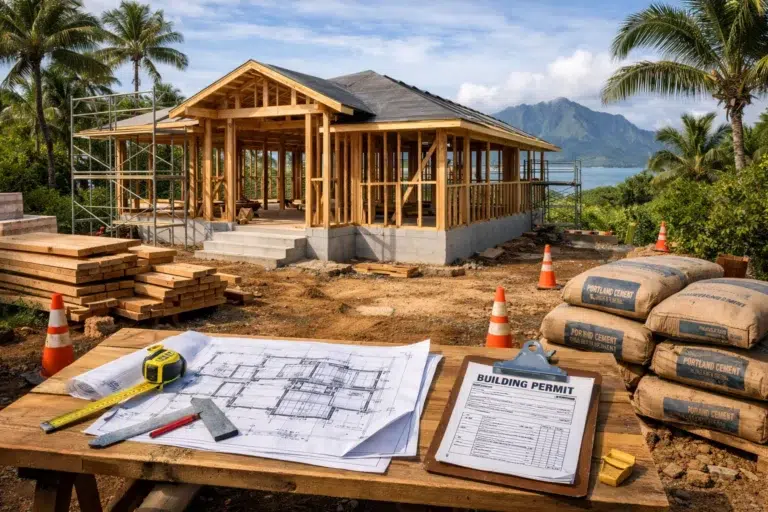
Construction projects in Hawaiʻi can involve conditions that make accurate documentation especially valuable.
Depending on the property and project location, contractors may encounter coastal exposure, moisture-related deterioration, difficult site access, shipping arrangements, or limited availability of certain materials.
For example, a renovation contractor might discover concealed water damage after removing existing cabinetry.
Addressing the damaged materials could require additional work beyond the original agreement.
The contractor should document the discovery, evaluate the proposed repair, and review the resulting scope and costs with the property owner.
Construction change orders in Hawaii help establish whether the additional work has been approved and how it affects the existing contract.
Understanding Hawaiʻi construction contract requirements
Hawaiʻi has specific requirements governing residential construction contracts.
Under Hawaiʻi Revised Statutes §444-25.5, covered home construction and improvement projects require written contracts containing specified information.
The Hawaiʻi Contractors License Board provides information about contractor licensing and applicable regulatory requirements.
Before approving major construction changes, property owners should review their existing contract and the requirements that apply to their project.
Public construction projects may also be subject to separate procedures administered under Hawaiʻi’s procurement framework. The Hawaiʻi State Procurement Office provides information about public contracting requirements.
These public procurement procedures should not automatically be applied to private residential construction projects.
1. Identify and Describe the Proposed Change
The first step in documenting construction change orders in Hawaii is identifying exactly what needs to change.
A change order should explain the difference between the original contract and the proposed work.
For example:
Original scope: Install the specified kitchen cabinetry according to the approved drawings.
Proposed change: Replace the specified cabinetry with a different product line and modify the layout to accommodate a larger refrigerator.
The documentation should identify which drawings, specifications, or selections are affected.
Clear descriptions of construction change orders in Hawaii help distinguish newly requested work from the scope already included in the signed agreement.
What information should be included?
A written change description should generally identify the project location, change order number, original scope, proposed modification, and supporting drawings or specifications.
If the modification affects electrical, plumbing, structural, or other regulated work, the contractor should determine whether additional professional coordination or approvals are required.
The goal is to make the proposed work understandable to everyone responsible for reviewing or performing it.
2. Document the Reason for the Change
Every proposed construction change should include an explanation of why it is being requested.
Common reasons include owner-requested improvements, design revisions, material substitutions, unforeseen site conditions, and necessary corrections to project documentation.
For example, a bathroom renovation may reveal deterioration beneath the existing flooring after demolition.
The contractor may need to assess the affected area and determine whether repairs require additional labor, materials, or professional evaluation.
Useful supporting records include photographs, site notes, inspection findings, updated drawings, and relevant correspondence.
These records provide context for why the modification was proposed.
For construction change orders in Hawaii involving concealed conditions, documenting the discovery before the affected area is covered or repaired can be particularly helpful.
A clear record can support discussions about the appropriate scope and allocation of costs under the existing contract.
3. Prepare a Written Cost Breakdown
One of the most important parts of managing construction change orders in Hawaii is understanding their financial impact.
The proposed change should identify additional costs, credits for deleted work, and the resulting adjustment to the contract amount.
For construction change orders in Hawaii, itemized pricing can help owners understand additional labor, materials, delivery charges, and credits before approving the revised contract amount.
Example of a construction change order cost breakdown
Consider a hypothetical kitchen renovation involving additional cabinetry and installation work.
| Cost component | Estimated amount |
|---|---|
| Additional cabinetry materials | $1,800 |
| Additional installation labor | $650 |
| Delivery and handling | $150 |
| Credit for deleted materials | −$400 |
| Net change | $2,200 |
These figures are illustrative only and do not represent a United Construction Group estimate or current Hawaiʻi market pricing.
The property owner should confirm whether applicable taxes, contractor overhead, markup, and other charges are included.
The change order should also explain how the revised amount affects the overall contract price.
A clearly documented adjustment helps prevent misunderstandings when progress payments or final invoices are issued.
4. Evaluate the Impact on the Construction Schedule
Not every change affects the project completion date.
However, some modifications can alter the sequence of work, material delivery requirements, and subcontractor scheduling.
For example, replacing an in-stock bathroom fixture with a special-order product could affect installation timing.
Other changes may require additional design coordination, inspections, or revised drawings.
Construction change orders in Hawaii should therefore identify whether the proposed modification:
-
Requires additional working days.
-
Changes material delivery assumptions.
-
Affects scheduled subcontractors.
-
Requires revised drawings or approvals.
-
Changes the anticipated project completion date.
How should schedule changes be documented?
A written change order should identify the anticipated schedule adjustment or explain how the impact will be determined.
If additional time is required, the parties should document the agreed extension according to the contract.
Construction change orders in Hawaii may involve material shipping and delivery considerations, but these conditions vary by supplier, location, and product.
Avoid treating an estimated material arrival date as a guaranteed project completion date.
Clear scheduling assumptions help owners and contractors coordinate the remaining work.
5. Obtain Written Approval Before Proceeding
Written authorization is one of the most important safeguards in the change order process.
For typical private renovation projects, a sound practice is to obtain approval from the authorized parties before beginning additional work, following the procedure established in the signed contract.
Written approval of construction change orders in Hawaii helps establish which changes were authorized, when they were approved, and how they affect the original contract.
What should a change order approval include?
An approval record should identify:
-
The project and change order number.
-
The agreed scope of the modification.
-
The cost adjustment.
-
The schedule adjustment, if applicable.
-
The date of approval.
-
The names or signatures of authorized parties.
The contract should be reviewed for specific provisions governing changes, approvals, disputes, and emergency work.
For covered public construction contracts, Hawaiʻi’s procurement rules establish additional procedures for written changes and contract adjustments.
The Hawaiʻi State Procurement Office’s contract modification guidance provides relevant information for public procurement.
Private construction agreements may use different procedures.
6. Update the Project Records and Budget
Once approved, construction change orders in Hawaii should become part of the project’s contract documentation.
The project team should update relevant records, including the budget, drawings, material selections, payment information, and construction schedule.
A change order log can make this process easier.
Example of a construction change order log
| Change order | Description | Status |
|---|---|---|
| CO-001 | Kitchen cabinet modification | Approved |
| CO-002 | Additional electrical outlet | Pending |
| CO-003 | Flooring material substitution | Under review |
The log should also record approval dates, cost adjustments, and schedule effects.
An approved change order should be clearly distinguishable from a proposed, rejected, or withdrawn change.
For projects involving multiple modifications, construction change orders in Hawaii can be tracked in a centralized project file to reduce confusion between contractors, property owners, and specialty trades.
This helps prevent unapproved modifications from being mistakenly included in project billing.
7. Keep Change Order Records Through Project Completion
Construction change orders in Hawaii should remain accessible throughout the project and after completion.
Property owners should retain the original signed contract, approved modifications, updated drawings, payment records, relevant correspondence, and applicable inspection documentation.
These records may be useful when reviewing final invoices, resolving discrepancies, understanding completed work, or planning future renovations.
Recommended project documentation
A complete project file may include the original contract and scope of work, approved drawings, signed change orders, material selections, invoices, payment records, permits, inspection reports, and warranty information.
Organizing these records by date or change order number makes them easier to retrieve.
A complete project file also helps clarify which materials and specifications were ultimately approved.
Common Mistakes to Avoid When Managing Construction Change Orders
Even well-planned projects can experience problems when changes are not communicated clearly.
Approving additional work verbally
Verbal conversations may not establish the exact price, scope, or schedule adjustment.
Whenever possible, confirm agreed modifications in writing before the additional work begins.
Assuming material substitutions have no cost impact
Replacing one material with another can affect more than the purchase price.
Installation requirements, fabrication, delivery, and compatibility with existing systems may also influence costs.
Signing incomplete change orders
Property owners should review documents carefully before approving changes.
Descriptions that lack clear pricing, specifications, or scheduling assumptions may require clarification.
Treating every unexpected condition as extra work
Not every unforeseen condition automatically qualifies as additional billable work.
Whether the work is outside the original scope depends on the contract, existing responsibilities, and circumstances.
Reviewing these issues before authorization can reduce avoidable disputes.
Frequently Asked Questions About Construction Change Orders in Hawaii
What should construction change orders in Hawaii include?
A change order should identify the project, original scope, proposed modification, reason for the change, cost adjustment, schedule impact, and approval information.
Supporting drawings, photographs, or specifications may also be necessary.
Do construction change orders in Hawaii need to be in writing?
Written documentation is strongly recommended.
Whether a particular modification legally requires a signed change order depends on the contract, project type, and applicable law.
Covered public construction contracts have specific written change procedures. Private residential projects should follow their contractual approval requirements.
Can a homeowner request changes after construction begins?
Yes. Homeowners can request modifications during construction.
However, the contractor must evaluate whether the proposed change is feasible and determine its potential cost and schedule impact.
Some requests may also require revised drawings, permits, or additional coordination.
Can a construction change order reduce the contract price?
Yes. A change order can document deleted work, material substitutions, or other agreed modifications that reduce the contract amount.
Any resulting credit should be clearly recorded.
Can a contractor charge for unexpected repairs?
Potentially.
The answer depends on the original contract, whether the repairs were included in the agreed scope, and the applicable contractual procedures.
The condition and proposed work should be documented before additional charges are approved, subject to applicable emergency or safety provisions.
Do construction change orders always delay a project?
No. Some changes can be completed without affecting the overall project schedule.
Others may require additional materials, labor, design coordination, or inspections.
Can construction change orders in Hawaii affect building permits?
Yes. A modification that changes approved plans or regulated work may require review or revised permit documentation.
Requirements depend on the project scope and the county or other authority having jurisdiction.
Who should approve a construction change order?
The parties authorized under the construction contract should approve the change.
This commonly includes the property owner or authorized representative and the contractor.
Commercial projects may have additional approval procedures involving architects, construction managers, or other designated representatives.
How should multiple construction change orders be tracked?
Use a numbered change order log showing each request, description, approval status, cost adjustment, and schedule impact.
Keep supporting documents with the corresponding change order.
What happens if a construction change order is disputed?
The parties should review the signed contract, proposed change, supporting records, and applicable dispute resolution procedures.
For significant disagreements, professional legal advice may be appropriate.
A Better Construction Process Starts With Clear Documentation
Construction changes are not necessarily a sign of poor planning.
Some result from new owner preferences, while others arise from conditions that could not reasonably be confirmed before work began.
What matters is how those changes are evaluated, communicated, and authorized.
Managing construction change orders in Hawaii with accurate records, clear communication, and documented approvals supports better project oversight from planning through completion.
By documenting proposed work, reviewing costs, confirming schedule impacts, and maintaining accurate project records, property owners can make more informed decisions throughout construction.
For homeowners and commercial property owners in Hawaiʻi, an organized change order process supports clearer communication and better project oversight.
Plan Your Next Project With United Construction Group
Planning a home renovation, commercial improvement, or construction project in Hawaiʻi?
United Construction Group can be contacted to discuss your project requirements, existing conditions, and proposed scope of work.
Whether you’re preparing for a renovation or reviewing potential changes during construction, starting with clear project information can help establish the next steps.
Explore our construction services or visit United Construction Group to discuss your project.