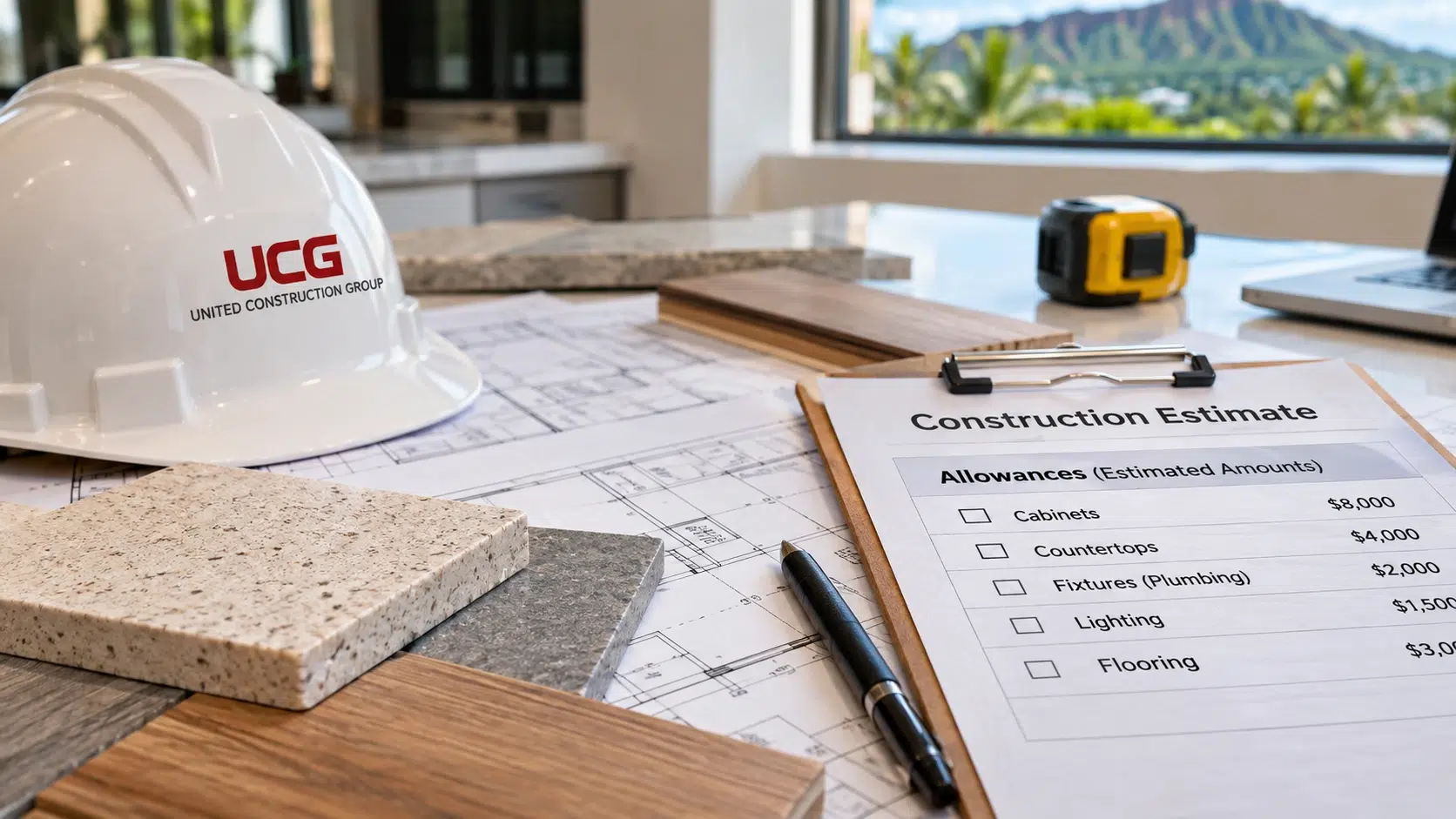
Construction allowances in Hawaii can significantly affect the final cost of a residential renovation, commercial build-out, or construction project. While an initial construction estimate may appear to fit your budget, allowances for materials, fixtures, finishes, and other selections can change as project details are finalized.
Understanding how these allowances work helps property owners compare contractor estimates, evaluate potential expenses, and make informed financial decisions before construction begins.
In Hawaii, material availability, interisland transportation, shipping expenses, and project-specific requirements can also influence the final cost of selected products.
At United Construction Group, we believe that clear communication and detailed project planning are essential to understanding construction costs.
This guide explains how construction allowances in Hawaii work, how they differ from fixed-price items, and seven essential ways to manage them when reviewing a construction estimate.
What Are Construction Allowances in Hawaii?
Construction allowances in Hawaii are estimated amounts included in a construction proposal for specific materials, products, or work that has not been completely defined or selected when the estimate is prepared.
For example, a homeowner planning a kitchen renovation may not have selected the final cabinetry, countertops, or plumbing fixtures.
Instead of excluding these items entirely, a contractor may include an allowance representing an agreed budget for those selections.
Common construction allowances include:
- Kitchen cabinets and countertops
- Bathroom fixtures and accessories
- Flooring materials
- Lighting fixtures
- Appliances
- Doors and hardware
- Tile and specialty finishes
- Certain work requiring further investigation or definition
Not every estimate uses allowances in the same way. Some cover materials only, while others may include labor, delivery, installation, or related expenses.
Important: Always confirm what each allowance includes and how any difference between the allowance and actual cost will be calculated.
How Do Construction Allowances Affect a Construction Estimate?
Construction allowances in Hawaii affect estimates because the final cost of an allowance item may differ from the amount originally budgeted.
Consider a hypothetical kitchen renovation.
| Allowance item | Budgeted amount | Final cost | Difference |
|---|---|---|---|
| Countertops | $4,000 | $5,200 | +$1,200 |
| Cabinet hardware | $600 | $450 | -$150 |
| Lighting fixtures | $1,500 | $1,900 | +$400 |
| Flooring materials | $3,000 | $3,600 | +$600 |
| Total | $9,100 | $11,150 | +$2,050 |
Illustrative amounts only; these are not current Hawaii contractor quotes or market prices.
In this example, the selected products cost $2,050 more than the original allowances.
The final contract adjustment may also depend on agreed taxes, delivery expenses, labor differences, and contractor markup.
This is why property owners should review allowances separately from other estimated construction costs.
1. Review Every Construction Allowance Before Signing
One of the most important steps in managing construction allowances in Hawaii is identifying every allowance listed in the contractor’s proposal.
An allowance should not appear as an unexplained amount.
Ask your contractor to identify:
- Which products or services are covered
- The amount allocated to each item
- Whether labor and installation are included
- Whether shipping and applicable taxes are included
- Who is responsible for selecting the product
- When the selection must be finalized
- How overages and savings will be handled
For example, a $3,000 flooring allowance could represent materials only or materials and installation.
These are very different pricing assumptions.
Practical tip: Request an itemized allowance schedule so you can compare estimated amounts with actual product selections.
2. Understand the Difference Between Allowances and Fixed Costs
Construction allowances in Hawaii should be distinguished from fixed-price work.
A fixed-price item generally has a defined scope and agreed contract amount, subject to the contract’s terms and any approved changes.
An allowance is a budgeted amount for an item that has not been fully specified.
| Fixed-price item | Allowance item |
|---|---|
| Defined scope or selection | Selection or details may remain open |
| Agreed contract pricing | Budgeted amount subject to adjustment |
| Less uncertainty about specified work | Actual cost may differ from allowance |
| Changes generally require contract adjustments | Adjustments follow the allowance provisions |
For example, demolition of a clearly defined kitchen area may be included as fixed-price work, while the final countertop material may remain an allowance.
However, even fixed-price construction contracts can change because of approved scope changes, unforeseen conditions, or other contract provisions.
Understanding this distinction helps property owners evaluate the actual certainty of a proposed construction budget.
3. Account for Material Availability and Shipping in Hawaii
Material availability is an important consideration when evaluating construction allowances in Hawaii.
Depending on the product and project location, materials may need to be sourced locally, shipped from the continental United States, or transported between islands.
Potential considerations include:
- Freight and delivery charges
- Product availability
- Supplier lead times
- Special-order materials
- Storage and handling requirements
- Delivery access to the construction site
- Replacement products if an original selection becomes unavailable
These factors do not affect every project equally.
For example, locally available flooring may have different delivery requirements than custom cabinetry ordered from an off-island manufacturer.
Before approving an allowance, ask whether the estimated amount includes transportation and delivery to the project location.
Practical tip: Confirm product availability and obtain written supplier pricing for major selections whenever possible.
4. Finalize Important Material Selections Early
One effective way to manage construction allowances in Hawaii is to finalize major material selections before construction begins.
The more selections that remain undecided, the more uncertainty may exist in the final budget.
For a kitchen renovation, early decisions may include:
- Cabinet style and finish
- Countertop material
- Flooring
- Sink and faucet
- Appliances
- Lighting fixtures
- Backsplash tile
For a commercial build-out, selections may include flooring systems, lighting, restroom fixtures, doors, and specialty finishes.
Finalizing these details early allows the project team to obtain more accurate supplier pricing and evaluate availability.
It may also help reduce delays caused by late selections or product substitutions.
Practical tip: Create a material selection schedule identifying each item, its allowance, the selected product, and the approval deadline.
5. Ask How Allowance Adjustments Are Calculated
Construction allowances in Hawaii can increase or decrease the final project price, depending on actual selections and the terms of the construction contract.
Suppose your bathroom renovation includes a $2,000 tile material allowance.
If the selected tile costs $2,600, the difference in material cost is $600.
However, the final adjustment may also include additional expenses if the selected product requires different installation methods, additional preparation, or increased delivery costs.
Ask your contractor:
- Will unused allowance funds be credited?
- How are costs exceeding the allowance calculated?
- Are contractor markups applied to adjustments?
- Are applicable taxes and shipping included?
- Does a change require written approval?
- When will the updated cost be communicated?
These questions help establish expectations before purchases are made.
Practical tip: Require written documentation of allowance adjustments and obtain approval before proceeding with selections that exceed the agreed budget.
6. Compare Contractor Estimates Using the Same Allowances
When comparing construction proposals, property owners should avoid evaluating the total estimated price alone.
When reviewing construction estimates in Hawaii, property owners should also verify that contractors hold the appropriate licenses for the proposed work. The Hawaii Professional & Vocational Licensing Division provides official licensing information to help property owners research contractor credentials before entering into a construction agreement.
Two contractors may provide different estimates because they have included different allowance amounts.
For example:
Contractor A
- Kitchen cabinet allowance: $8,000
- Countertop allowance: $3,000
- Flooring allowance: $2,000
Contractor B
- Kitchen cabinet allowance: $12,000
- Countertop allowance: $5,000
- Flooring allowance: $3,500
The second proposal includes $7,500 more in allowances.
That does not automatically mean the second contractor is more expensive for the same work.
The proposals may be based on different product quality levels, selections, or inclusions.
Before comparing totals, confirm that each estimate uses equivalent specifications and allowance assumptions.
For additional guidance, read our article on How to Compare Construction Bids Beyond the Bottom Line.
Practical tip: Request comparable allowance schedules from each contractor so you can evaluate pricing on a consistent basis.
7. Include a Contingency Budget for Unexpected Costs
Even with carefully reviewed construction allowances in Hawaii, unexpected expenses may arise during renovation or construction.
Possible causes include:
- Concealed water damage
- Structural deterioration
- Outdated electrical or plumbing systems
- Unforeseen site conditions
- Owner-requested design changes
- Material substitutions
- Additional work required after investigation
A construction contingency is different from an allowance.
An allowance provides a budget for a particular item that has not been fully specified.
A contingency is a separate amount reserved for potential unexpected expenses.
The appropriate contingency depends on the project scope, existing conditions, and level of uncertainty.
Older buildings or projects involving concealed systems may require more careful risk planning.
Discuss the appropriate contingency with your contractor and design professionals rather than relying on a universal percentage.
Practical tip: Keep allowance adjustments and contingency spending separately documented to maintain a clearer picture of the project budget.
Construction Allowances in Hawaii: Questions to Ask Your Contractor
Before approving a construction proposal, property owners should review the following questions:
- Are all construction allowances clearly identified?
- What products, materials, or services does each allowance cover?
- Are labor, installation, shipping, and applicable taxes included?
- Are allowance amounts based on current supplier pricing?
- What happens if the selected product costs more?
- Will unused allowance funds be credited?
- Are there additional charges for substitutions?
- Who approves changes to allowance amounts?
- When must final selections be completed?
- How will the contractor document changes to the final price?
A written discussion of these questions can help reduce misunderstandings and improve budget transparency.
Frequently Asked Questions About Construction Allowances in Hawaii
What is a construction allowance?
A construction allowance is a budgeted amount included in a construction estimate for materials, products, or work that has not been fully specified. The final cost may be adjusted according to actual selections and contract terms.
Are construction allowances included in the total estimate?
Generally, allowances listed in a contractor’s proposal are included in the estimated contract amount. However, property owners should verify this in writing because proposal formats and contract terms vary.
Can construction allowances increase the final project cost?
Yes. If actual selections exceed the budgeted allowance, the final project cost may increase. Additional installation, shipping, taxes, or other agreed charges may also apply.
What happens if I spend less than my allowance?
Unused allowance amounts may be credited to the owner, depending on the contract. Review the allowance adjustment provisions before signing.
Why are construction allowances important in Hawaii?
Construction allowances in Hawaii can be affected by product availability, shipping requirements, transportation between islands, and project-specific material selections. Clear allowances help property owners understand potential changes to estimated costs.
What is the difference between an allowance and a contingency?
An allowance is a budget for a specific item that has not been fully selected or defined. A contingency is a separate reserve intended to address potential unexpected project costs.
Should I remove allowances from my construction contract?
Not necessarily. Allowances can be useful when certain selections cannot be finalized before signing. However, reducing unnecessary allowances and clearly documenting those that remain can improve cost predictability.
How can I avoid exceeding my construction allowances?
Review the allowance schedule, finalize major selections early, obtain supplier pricing, confirm included expenses, and require written approval for changes.
Plan Your Construction Budget With Confidence
Understanding construction allowances in Hawaii is an important part of evaluating residential and commercial construction estimates.
A clear estimate should explain what is included, what remains undecided, and how future adjustments will be handled.
By reviewing allowance amounts, confirming product availability, comparing contractor proposals, and documenting changes, property owners can make better-informed decisions and reduce avoidable budget surprises.
United Construction Group works with property owners planning residential renovations, commercial improvements, and construction projects in Hawaii.
Whether you are preparing for a kitchen renovation, bathroom remodel, or commercial build-out, discussing project requirements and estimated costs early can help establish clearer expectations.
Explore our construction services or contact United Construction Group to discuss your project and the next steps in planning.
Build with clarity. Plan with confidence.