A construction scope of work in Hawaii is one of the most important documents to review before starting a residential renovation, commercial build-out, or property improvement project.
A clearly written scope of work identifies what your contractor is responsible for, which materials will be used, how the project will be managed, and what is excluded from the agreed price.
Without clear documentation, property owners may encounter unexpected expenses, scheduling disagreements, and confusion about project responsibilities.
In Hawaii, construction planning may also involve coastal exposure, heavy rainfall, site accessibility, material transportation, and county-specific permitting requirements.
In this guide, United Construction Group explains 10 essential items to include in a construction scope of work in Hawaii and how proper documentation can help property owners plan with greater confidence.
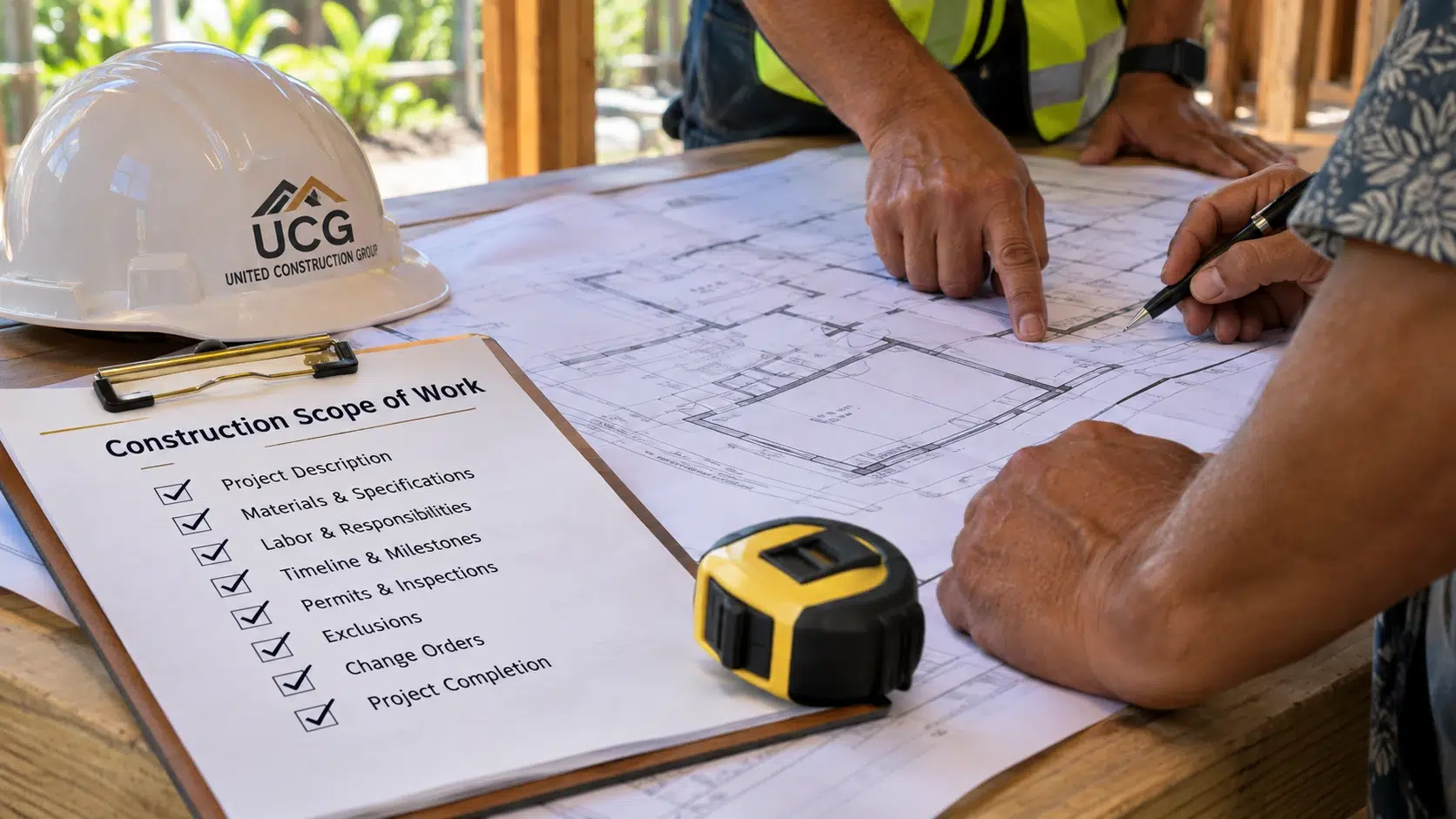
1. Construction Scope of Work in Hawaii: Project Description
Every construction scope of work in Hawaii should begin with a detailed project description.
This section explains the purpose of the project, the location of the work, and the expected results.
For example, a kitchen renovation may include demolition, electrical modifications, plumbing adjustments, cabinetry installation, flooring, and finishing work.
A commercial build-out may require additional coordination involving mechanical systems, accessibility, fire protection, and inspections.
Your project description should identify:
- Property address and project location.
- Type of construction or renovation.
- Areas included in the work.
- Major construction activities.
- Expected project deliverables.
A detailed description helps property owners and contractors establish a shared understanding before construction begins.
2. Existing Property Conditions and Site Assessment
Before finalizing a construction scope of work in Hawaii, document the existing condition of the property.
A site assessment may identify visible damage, structural concerns requiring further investigation, drainage issues, and access limitations.
Depending on the project, contractors and qualified professionals may review:
- Existing walls, floors, and roofing.
- Visible moisture damage or corrosion.
- Electrical and plumbing systems.
- Site accessibility and material delivery routes.
- Existing plans and available building records.
A visual inspection cannot reveal every concealed condition. Additional testing or professional evaluation may be necessary.
Why it matters: Understanding existing conditions helps contractors prepare more accurate proposals and identify potential construction challenges.
3. Materials and Product Specifications
A detailed construction scope of work in Hawaii should specify the materials and products included in the project.
General descriptions such as “new flooring” or “updated fixtures” may create confusion when comparing contractor estimates.
Instead, identify relevant product specifications, including:
- Material type and finish.
- Manufacturer or approved equivalent.
- Product dimensions and quantities.
- Installation requirements.
- Responsibility for purchasing and delivery.
For properties exposed to coastal conditions, material selection may also require consideration of corrosion resistance and maintenance requirements.
Clearly documented selections help establish expectations for both pricing and workmanship.
4. Labor and Contractor Responsibilities
Your construction scope of work in Hawaii should explain who is responsible for completing and coordinating each part of the project.
Construction work may involve general contractors, electricians, plumbers, specialty trades, designers, and other qualified professionals.
The scope should identify:
- Contractor responsibilities.
- Specialty trade coordination.
- Owner-supplied materials.
- Site supervision and communication.
- Required inspections and testing.
- Responsibility for protecting existing property.
Property owners should also verify applicable contractor licensing and insurance.
In Hawaii, contractor licensing is administered through the Department of Commerce and Consumer Affairs.
Before hiring a contractor, property owners should verify the contractor’s licensing status through the Hawaii Department of Commerce and Consumer Affairs (DCCA). Checking licensing information is an important step when evaluating construction professionals in Hawaii.
5. Construction Timeline and Project Milestones
A construction scope of work in Hawaii should establish a realistic schedule and identify important project milestones.
Depending on the work, these may include:
- Preconstruction planning.
- Permit approvals.
- Material procurement.
- Demolition and site preparation.
- Rough-in work and inspections.
- Installation and finishing.
- Final inspection and project closeout.
Construction timelines may change because of permit reviews, material availability, weather, approved changes, or unforeseen conditions.
A written schedule should explain how delays will be communicated and how updates will be handled.
6. Permits and Regulatory Requirements
Permitting responsibilities are an important part of a construction scope of work in Hawaii.
Requirements vary depending on the property location, proposed work, and applicable county regulations.
For example, projects on Oahu may require review through the City and County of Honolulu Department of Planning and Permitting.
Other counties have their own permitting authorities and procedures.
Your scope should clarify:
- Who determines which permits are required.
- Who prepares and submits applications.
- Who pays applicable permit fees.
- Who coordinates required inspections.
- Who maintains approved plans and permit records.
Do not assume that every renovation requires the same permits. Confirm requirements with the appropriate county agency and qualified professionals.
7. Construction Costs and Payment Terms
A complete construction scope of work in Hawaii should align with the contractor’s written estimate and payment agreement.
Property owners should understand what the quoted price includes before signing.
Review the following:
- Itemized construction costs.
- Material and labor allowances.
- Excluded services or products.
- Payment milestones.
- Procedures for additional work.
- Applicable taxes and fees.
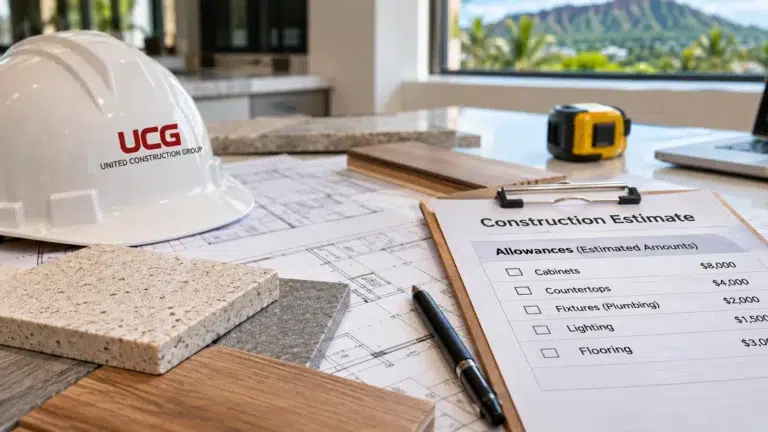
An allowance is a budgeted amount for an item that has not yet been fully selected or priced.
If actual selections exceed the allowance, the final cost may change according to the contract.
Important: A lower estimate does not always represent better value when significant work or materials are excluded.
8. Exclusions and Unexpected Conditions
Clearly stated exclusions are essential when preparing a construction scope of work in Hawaii.
Exclusions identify work that is not included in the agreed project price.
Examples may include:
- Repairs to concealed structural damage.
- Hazardous material testing or remediation.
- Unspecified utility upgrades.
- Additional engineering services.
- Landscaping or exterior restoration.
- Owner-requested design changes.
Existing buildings may contain conditions that cannot be confirmed until demolition or further investigation.
The agreement should explain how unexpected conditions will be documented, priced, and approved before additional work proceeds.
9. Change Orders and Project Communication
Construction projects sometimes require changes after work begins.
A construction scope of work in Hawaii should establish a clear process for reviewing and approving those changes.
A written change order should generally identify:
- Description of the proposed change.
- Reason for the adjustment.
- Additional or reduced cost.
- Impact on the construction schedule.
- Required approvals.
The contract should explain who has authority to approve changes and when approval must occur.
Clear communication helps reduce misunderstandings and provides a written record of important decisions.
10. Final Inspections, Cleanup, and Project Completion
The final section of a construction scope of work in Hawaii should explain what constitutes project completion.
Depending on the project, closeout responsibilities may include:
- Final walkthrough and punch list.
- Required inspections and approvals.
- Construction debris removal.
- Final site cleanup.
- Equipment manuals and warranties.
- Applicable permit and inspection records.
- Final payment and closeout documentation.
A punch list identifies outstanding items that must be addressed before final acceptance.
Written closeout expectations help property owners understand what they should receive when construction is completed.
Hawaii-Specific Construction Planning Considerations
A construction scope of work in Hawaii should reflect the conditions of the actual property rather than relying entirely on a generic template.
Important considerations may include:
Coastal exposure: Properties near the ocean may require special attention to corrosion resistance and material durability.
Heavy rainfall: Drainage, waterproofing, and moisture management may influence construction planning.
Site accessibility: Narrow roads, limited staging areas, and restricted delivery access can affect logistics.
Material availability: Certain materials or specialty products may require additional procurement time.
County requirements: Permitting, zoning, and inspection procedures depend on the applicable jurisdiction.
These considerations should be evaluated based on the project location and proposed work.
Construction Scope of Work in Hawaii: Preconstruction Checklist
Before approving a proposal, review the following checklist:
-
Project description and work areas are clearly identified.
-
Existing property conditions have been documented.
-
Materials and product specifications are listed.
-
Contractor and owner responsibilities are defined.
-
Project milestones and scheduling assumptions are explained.
-
Permit and inspection responsibilities are assigned.
-
Pricing, allowances, and payment terms are documented.
-
Exclusions and unexpected conditions are addressed.
-
Change order procedures are established.
-
Final inspections, cleanup, and closeout requirements are included.
This checklist can help property owners identify missing information before approving construction work.
Frequently Asked Questions About Construction Scope of Work in Hawaii
What is a construction scope of work in Hawaii?
A construction scope of work in Hawaii is a written document describing the work included in a construction project. It typically identifies materials, labor, responsibilities, timelines, exclusions, and expected deliverables.
Why is a construction scope of work important?
A clear scope helps property owners and contractors understand project expectations, compare estimates, and document responsibilities before work begins.
Does every construction project need a scope of work?
A written scope is valuable for projects of all sizes. The required level of detail depends on the work, applicable legal requirements, and the complexity of the project.
Who prepares the construction scope of work?
The scope may be developed by a contractor, designer, architect, engineer, or project team, depending on the project and contractual arrangement.
Can a construction scope of work change?
Yes. Changes may be necessary because of owner requests, unforeseen conditions, or revised project requirements. The contract should establish how changes are documented and approved.
Does a construction scope of work include permits?
It should identify relevant permitting and inspection responsibilities. Actual permit requirements depend on the project and local jurisdiction.
What happens if work is missing from the scope?
Missing work may require clarification, revised pricing, or a formal change order. Property owners should resolve uncertainties before signing whenever possible.
How detailed should a construction scope of work be?
It should be detailed enough for the parties to understand the included work, exclusions, responsibilities, materials, and expected results.
Plan Your Construction Project With United Construction Group
A well-prepared construction scope of work in Hawaii provides a foundation for clearer communication, more accurate estimates, and better project coordination.
Whether you’re planning a residential renovation, commercial improvement, or property upgrade, reviewing the scope before construction begins can help identify important decisions and reduce avoidable misunderstandings.
United Construction Group works with property owners planning residential and commercial construction projects in Hawaii.
Explore our construction services or contact United Construction Group to discuss your project requirements and next steps.